Client Login




Global equity markets delivered mixed but generally positive returns over the week in local currency terms, although in Sterling terms global and US equities were fairly flat. Oil prices fell –4.5%, providing relief for energy importers. Investor sentiment was driven by central bank decisions, AI-related volatility and developments in the Middle East. The Federal Reserve, Bank of England and Bank of Japan all held interest rates steady, and the latter left the door open for further tightening.
Last week
- US technology earnings continued to impress, prompting analysts to raise S&P 500 earnings growth expectations for Q2 to 47.4%, which would represent the strongest quarterly earnings growth rate in five years if maintained.
- US economic data was mixed, with inflation easing modestly but GDP growth slowing and consumer confidence weakening, suggesting some caution among households despite resilient corporate profitability.
- European equities reached new highs, supported by strong earnings, improving sentiment towards technology stocks and resilient economic growth. Eurozone GDP exceeded expectations.
- UK gilt yields moved higher overall last week, reflecting concerns that inflation could remain sticky and that interest rates may stay elevated for longer, despite the Bank of England keeping rates unchanged at 3.75%. The 10-year gilt yield ended the week at roughly 5.04%-5.06%, compared with around 5.00% at the start of the week. The 30-year gilt yield rose to around 5.78%, highlighting continued pressure on longer-dated government bonds.
- The FTSE 100 gained 1.2% and reached fresh record highs, driven by strong earnings and gains from major constituents including NatWest, Shell, BP, Glencore, Rio Tinto, Unilever and Weir. However, earnings growth remains concentrated in sectors such as banks, energy and mining.
- Asian markets were mixed. Japan weakened amid earthquake-related disruption and expectations of further Bank of Japan rate rises, while Hong Kong outperformed on strength in large technology stocks. Mainland Chinese equities lagged as manufacturing activity slipped back into contraction despite continued government support for economic growth and technology development.
This week
- US Unemployment data (Thursday) and Non-Farm Payrolls (Friday) – Markets will focus on job creation, unemployment and wage growth following this release.
- US ISM Services PMI (Wednesday) – This release gives the health of the US services sector, which accounts for 70% of GDP. Additionally, Disney, Uber, McDonalds and Shopify earnings are due this week and will give consumer and growth indicators.
- Advanced Micro Devices earnings will be released on Tuesday and will give a read-through on AI demand which has the potential to impact markets.
- BP earnings are also due on Tuesday, this will give information on the impact of softening yet volatile oil prices and a general sense of energy sector sentiment.
- China PMI data (relevant for commodities and UK miners) will be released on Wednesday. It is a leading indicator of the health of the world’s second-largest economy.
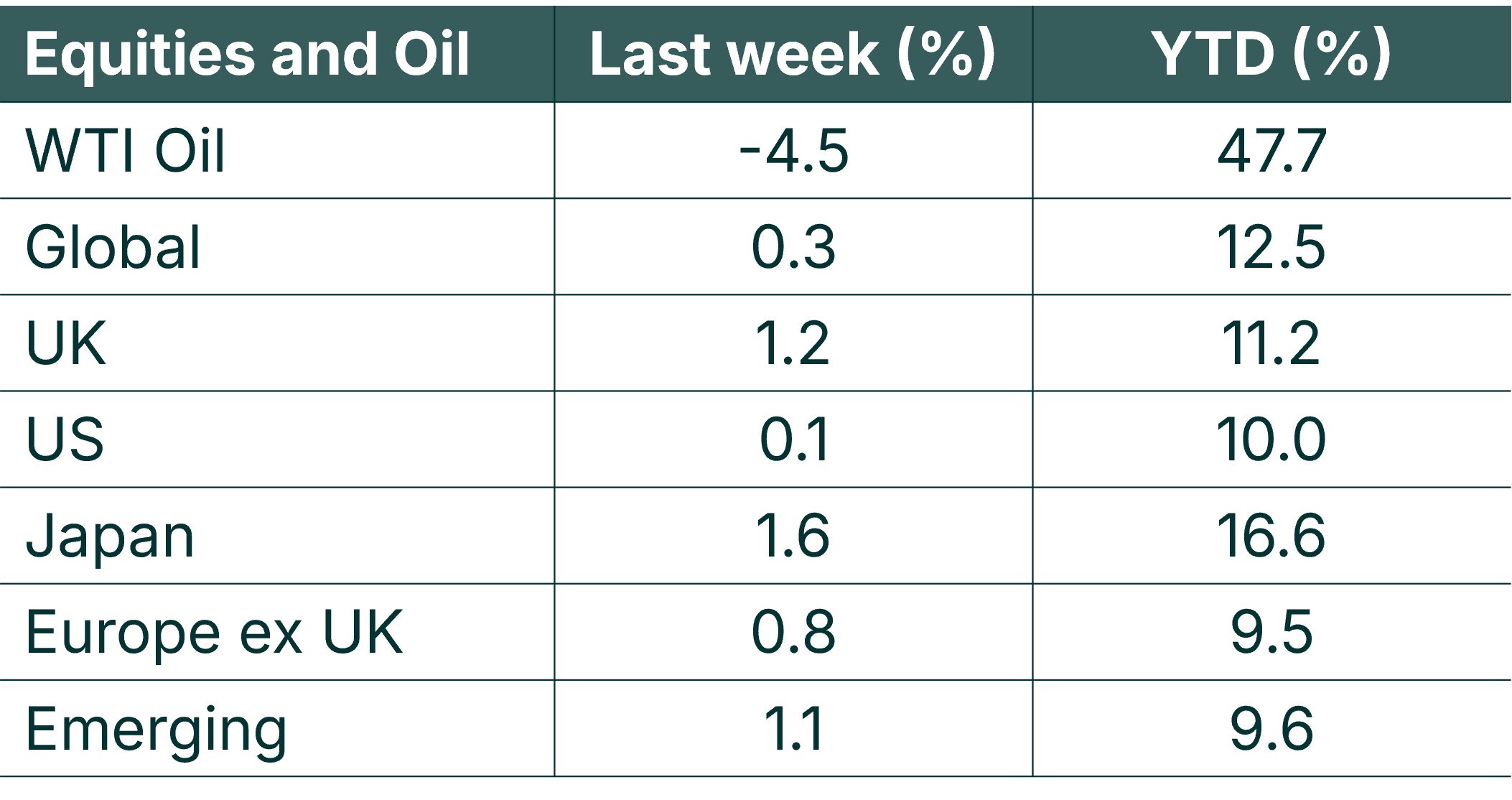
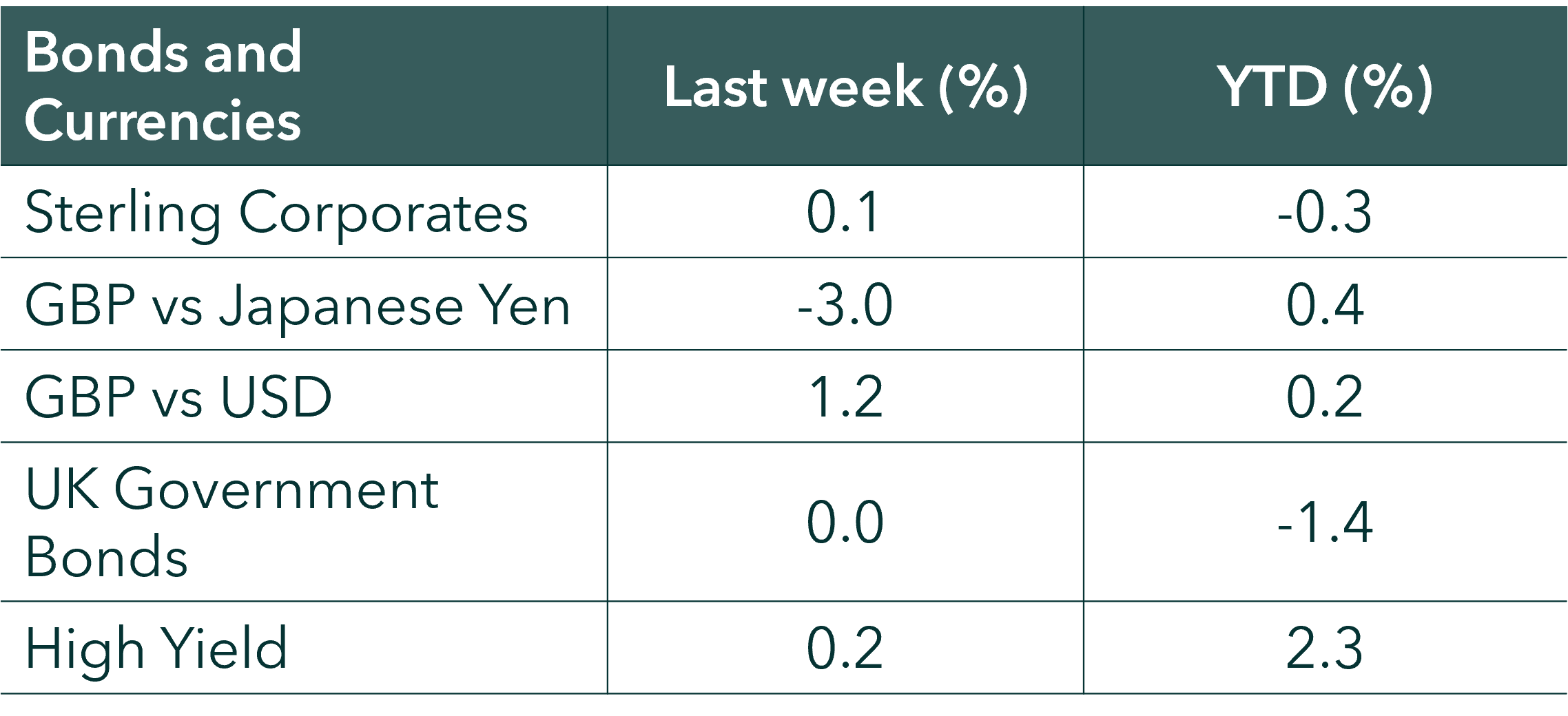
Source: Bloomberg. Currency GBP.
More details
Starting with the positive news: Strong earnings from the largest US technology companies prompted analysts to raise profit forecasts considerably. With almost two-thirds of S&P 500 companies having reported second-quarter results, expected earnings growth has increased to 47.4%, compared with 38.0% a week earlier, according to FactSet. Should this level be sustained, it would mark the fastest pace of quarterly earnings growth seen in the past five years.
The Federal Reserve kept interest rates unchanged at 3.50%-3.75%, although an unusual three policymakers dissented in favour of a rate rise, reflecting ongoing inflation concerns. Bond markets remained volatile, with the 30-year Treasury yield rising above 5.2%, its highest level since 2007.
US economic data painted a mixed picture. Inflation eased modestly, with core PCE inflation falling to 3.3% year-on-year, while GDP growth slowed to an annualised 1.5% in Q2, below expectations. Consumer confidence also weakened, highlighting some caution among households.
European equities performed strongly, with the STOXX Europe 600 reaching a new high. Strong corporate earnings, improving sentiment towards technology stocks and lower oil prices supported gains.
Eurozone GDP surprised positively, growing 0.4% in Q2, while inflation edged up to 2.9%. Germany’s economy expanded slightly faster than expected despite rising unemployment.
The FTSE 100 had a strong week overall, supported by a combination of robust corporate earnings, rising energy prices and continued optimism around UK earnings growth. The index finished the week up 1.2%, reaching fresh record highs during the period. Natwest, Shell, BP, Glencore, Rio Tinto, Unilver and Weir all made gains over the week.
Corporate profitability remains a key support for UK equities, although earnings growth remains concentrated in a relatively small number of sectors such as banks, energy and mining.
Japanese markets declined modestly last week amid uncertainty following a major earthquake in Kyushu and concerns around supply chain disruptions.
The Bank of Japan maintained its policy rate at 1% but signaled that further rate increases remain possible, potentially as soon as September. Inflation continued to move towards the Bank’s target, while a sharp appreciation in the Yen prompted speculation that authorities had intervened to support the currency.
Chinese markets diverged, with mainland shares pressured by a sell-off in AI-related stocks, while Hong Kong outperformed on strength in large internet companies.
Investor attention on the mainland focused on the successful IPO of memory-chip maker CXMT, highlighting strong demand for domestic technology champions. Policymakers reiterated support for economic growth, technology development and domestic demand but stopped short of announcing broad stimulus measures. Manufacturing activity slipped back into contraction, indicating continued weakness in the Chinese economy.
In closing, it is worth considering the slightly longer lens provided by equity market movements in July, where global equity returns were mixed in over the month when viewed from a Sterling investor’s perspective. Hong Kong was the strongest-performing major market, while UK equities delivered solid gains supported by strong corporate earnings. Developed markets generally remained resilient, although US and European equity returns were dampened by Sterling strength once converted from local currency. Emerging markets, Japan and mainland China lagged amid concerns over economic growth, technology sector volatility and weaker investor sentiment.
The value of investments and the income from them can go down as well as up and you could get back less than you invested. Past performance is not a reliable indicator of future performance.
The content of this article is not intended to be or does not constitute investment research as defined by the Financial Conduct Authority. The content should also not be relied upon when making investment decisions, and at no point should the information be treated as specific advice. The article has no regard for the specific investment objectives, financial situation or needs of any specific client, person, or entity.