Client Login




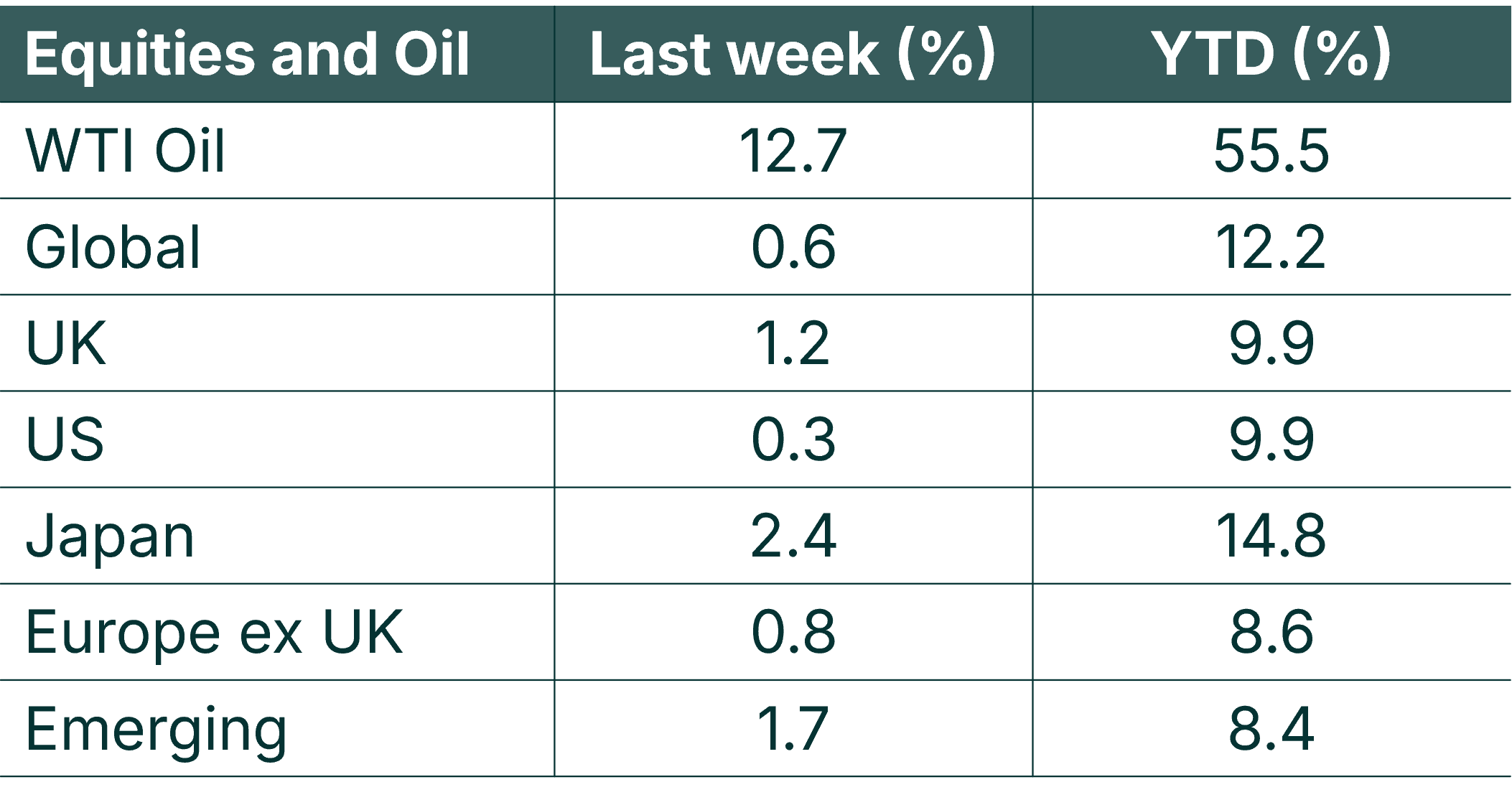
Global equities rose modestly in a choppy week, although the gains experienced by Sterling-based investors were driven almost entirely by weakness in the Pound against the US Dollar rather than stronger underlying equity markets. Rising oil prices, following renewed conflict in the Middle East, supported UK equities (given their relatively high exposure to the energy sector) but also pushed bond yields higher.
Meanwhile, despite generally strong earnings, several high-profile US technology companies came under pressure as investors questioned the scale of their AI-related spending. That theme remains front and center this week, with Meta, Microsoft and Amazon all reporting results alongside policy meetings from the US Federal Reserve and Bank of England.
Last week
- Global equities rose in Sterling terms, with gains largely driven by Pound weakness against the US Dollar.
- UK equities outperformed, benefiting from their relatively high exposure to the energy sector.
- US earnings remained robust, although Tesla and Alphabet weighed on index performance as investors questioned elevated AI investment.
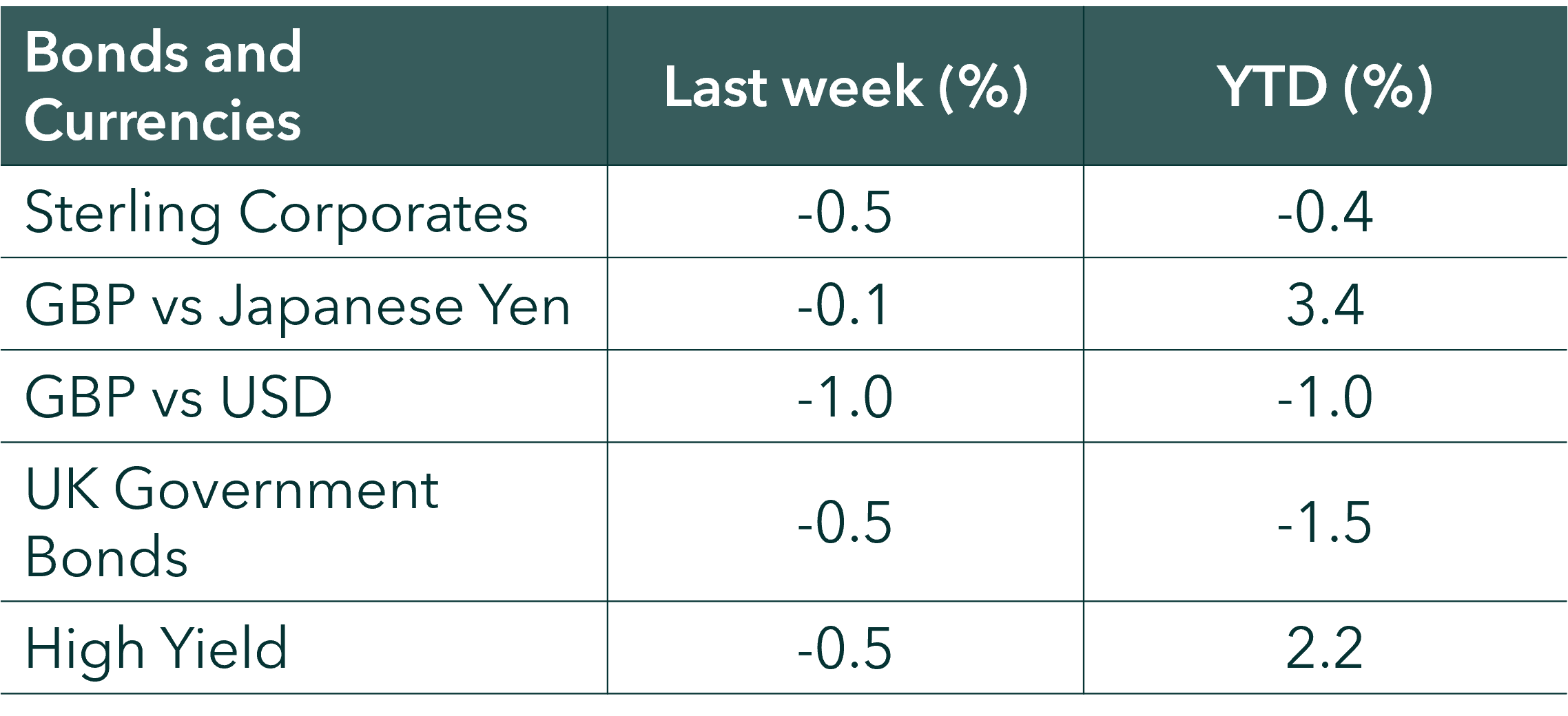
- Bond yields rose, weighing on bond prices, although US real yields are now at their most attractive levels since September 2024.
- The ECB left interest rates unchanged at 2.25%.
This week
- Along with the continued focus on developments in the Middle East, markets will be focused this week on corporate earnings and Central Bank policy meetings.
- The US Federal Reserve (Weds), Bank of England (Thurs) and Bank of Japan (Friday) all have policy meetings. All 3 are expected (by bond futures markets) to remain on hold, but commentary around future guidance will be closely watched.
- Around one-third of US companies report their earnings this week including Meta, Microsoft (both weds), Apple and Amazon (both Thursday).
- Some of the biggest UK companies also report this week, including Lloyds, Barclays and Rolls Royce.
- We’ve also got Q2 growth data for the Eurozone and US being released this week on Thursday.
Source: Bloomberg. Currency GBP.
More details
- Global equities rose modestly in Sterling terms, although the gain was entirely attributable to weakness in the Pound rather than a rise in underlying markets.
- Despite rising in Sterling terms (after currency translation), the US share market was choppy and mildly negative on the week in US Dollar terms.
- Ongoing hostilities in the Middle East served to stoke oil prices, which contributed to higher bond yields as inflation concerns were renewed. Brent Crude oil closed the week priced at just shy of $97/barrel, with Energy being the best performing equity sector on the week.
- The UK share market rose by just over 1% last week, helped by its relatively large weight (c9%) to the energy sector. The UK market is not only a relatively cheap market (trading on 13x forward earnings) but it also offers excellent sector divergence from most other equity markets; notably the US and Global share markets which are dominated by the technology sector (c37.5% of the US share market) and have very little exposure to the energy sector (energy makes up c3% of the US share market). The UK market also benefited from more takeover activity last week, with Mitie Group being the latest company to attract a bid – a £3.1 billion cash takeover offer from rival facilities management firm OCS group.
- US earnings came in strong last week, but there was some negative share price action from large constituents within the index, with Tesla falling around 17% on the week and Alphabet declining around 7%. In both cases, investors focused less on the headline earnings numbers and more on the growing cost of AI investment. Tesla, which missed earnings but beat revenue expectations, reported negative free cash flow as investment in AI, robotics and autonomous driving continued to accelerate. Alphabet, despite beating both earnings and revenue forecasts, came under pressure after increasing its expected 2026 capital expenditure guidance to $195bn-$205bn (from $180bn-$190bn previously). As a result of this increased spending, Alphabet also reported negative free cash flow for the quarter—the first time it has done so as a public company.
- Despite the recent pressure within the technology sector, it is worth noting that it trades on a more reasonable forward P/E multiple of 22.5x – a level which is below both its 5- and 10-year averages. The tech sector has now pulled back about 10% from its highs at start June and is still up c30% from its end March levels.
- Bond markets sold off by about 0.5% last week, with bond yields rising. The UK 10-year gilt closed out the week trading at 5.03%, with 2-year gilt yields trading at around 4.4%. Last week also saw a push higher in real yields (i.e. the return that investors get after adjusting for inflation). This was most pronounced in the US, where short-dated bonds (2-year treasuries) now offer a real yield of 2.1%. This is the highest level since September 2024 and reinforces the improving risk-reward available in short-dated government bonds.
- The ECB left rates unchanged at 2.25%. Markets interpreted President Lagarde’s comments on renewed geopolitical tensions and commodity prices as slightly more hawkish, leading bond futures to price a greater probability of a rate increase at the September meeting.
The value of investments and the income from them can go down as well as up and you could get back less than you invested. Past performance is not a reliable indicator of future performance.
The content of this article is not intended to be or does not constitute investment research as defined by the Financial Conduct Authority. The content should also not be relied upon when making investment decisions, and at no point should the information be treated as specific advice. The article has no regard for the specific investment objectives, financial situation or needs of any specific client, person, or entity.