Client Login




Last week, global markets experienced a more challenging week, with investors balancing resilient economic data and the start of the second-quarter earnings season against renewed geopolitical tensions and higher oil prices. Technology shares came under pressure following a period of exceptional performance, while energy stocks performed well as concerns over potential supply disruptions in the Middle East lifted crude prices. Fixed income markets were more resilient as softer inflation data provided some support, although bond yields remained volatile amid shifting interest rate expectations.
In the week ahead, investor attention will remain focused on developments in the Middle East, the busiest week of the US earnings season so far, and a series of important economic releases that will provide further insight into the health of the global economy and the outlook for central bank policy. In the UK, investors will also be watching developments in Westminster, with a change of occupier at 10 Downing Street and possible implications for fiscal and economic policy.
Last week
Global equity markets finished broadly lower as geopolitical risks re-emerged and investors took profits in parts of the technology sector, despite strong earnings updates from TSMC and ASML.
- Second-quarter earnings season began to heat up, with the major US banks delivering generally resilient results. Investors focused closely on management commentary around consumer spending, credit quality and the economic outlook.
- Technology stocks were more volatile, with semiconductor shares underperforming as investors reassessed elevated valuations following a prolonged period of AI-driven gains.
- Oil prices moved sharply higher as tensions in the Middle East intensified, reviving concerns over inflation and potential disruption to global energy supplies.
- US inflation data was marginally softer than expected, helping support bond markets and reinforcing expectations that the Federal Reserve may still be able to ease policy later this year, although markets remain data dependent.
This week
Markets have begun the week cautiously as investors monitor the latest developments in the Middle East, with oil prices remaining elevated and geopolitical headlines likely to drive short-term market sentiment.
It will be a busy week for the US corporate earnings season, with Alphabet, Tesla, Intel, IBM, American Express and Verizon among the companies due to announce quarterly results. Their outlook statements will be closely watched for evidence of continued AI investment, consumer resilience and corporate spending trends.
The economic calendar includes an ECB interest rate decision, Japan inflation data, European PMI data and several key UK data updates, including unemployment, inflation and retail sales.
Investors will also continue to assess whether stronger energy prices begin feeding through into inflation expectations and the outlook for global interest rates.
Political developments will also be in focus in the UK, as Andy Burnham is expected to become Prime Minister today. Investors are likely to focus on Cabinet appointments and the new government’s approach to economic growth and fiscal discipline
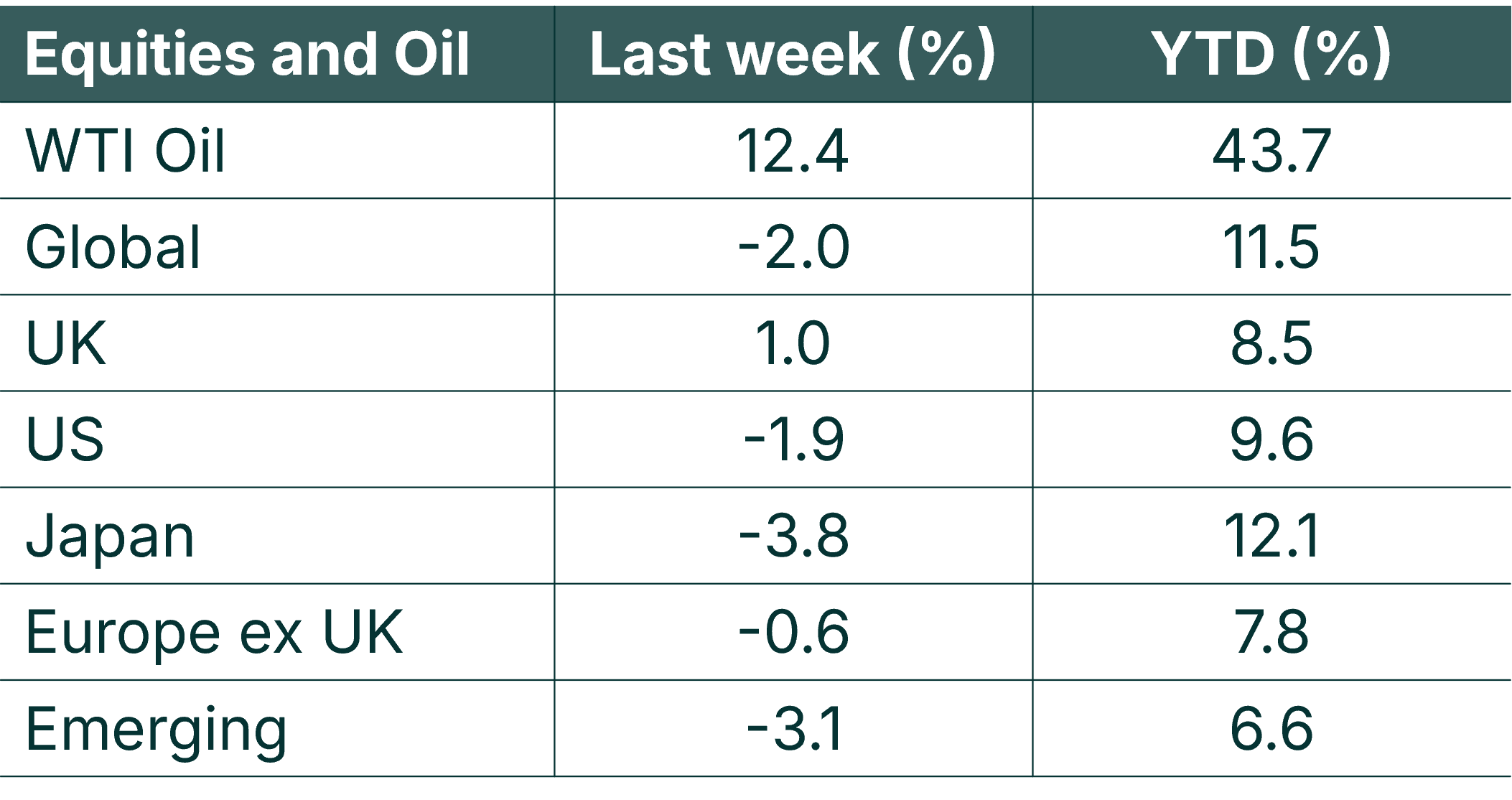
Source: Bloomberg. Currency GBP.
More details
Markets spent much of last week weighing two competing narratives. On one hand, inflation data has continued to improve gradually, and corporate earnings have, so far, largely met expectations. On the other hand, renewed geopolitical tensions have pushed energy prices higher, increasing uncertainty around the inflation outlook and the timing of future interest rate cuts.
Artificial intelligence remains one of the dominant investment themes, although leadership within the sector has become more selective. After an exceptional period of performance, semiconductor shares experienced weakness as investors questioned whether current valuations fully reflect future earnings potential. Nevertheless, spending on AI infrastructure continues to support longer-term expectations for technology investment.
This week’s earnings announcements are likely to be particularly important for market direction. Beyond headline results, investors will be listening carefully for commentary on capital expenditure, AI investment, consumer demand and the potential impact of higher energy costs. With equity valuations remaining elevated in several sectors, management guidance may prove just as influential as the reported numbers themselves.
The value of investments and the income from them can go down as well as up and you could get back less than you invested. Past performance is not a reliable indicator of future performance.
The content of this article is not intended to be or does not constitute investment research as defined by the Financial Conduct Authority. The content should also not be relied upon when making investment decisions, and at no point should the information be treated as specific advice. The article has no regard for the specific investment objectives, financial situation or needs of any specific client, person, or entity.