Opportunities in Gilts

Emma Matthews, Investment Manager, Magnus

Our clients who hold longer term investments also typically retain an element of cash, usually in a bank account or savings account. Whilst having some cash savings is sensible, low-risk alternatives products do exist that can offer better returns.

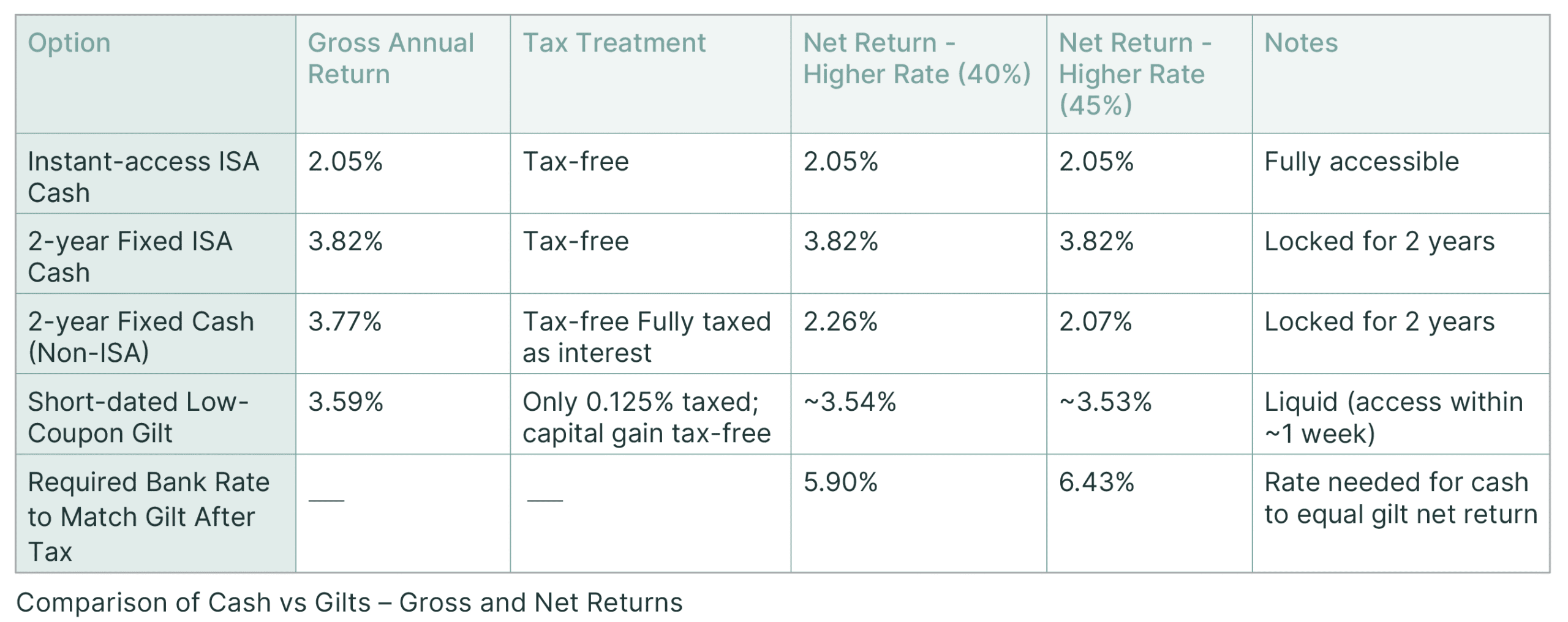
One area we’re increasingly talking to clients about is using direct gilts – a low-risk investment that can have valuable tax advantages, giving the potential to meaningfully boost the return received.

As a consequence of the UK’s Bank of England interest rates coming down gradually, we have all seen savings rates falling on bank accounts. Plus, for many of our clients, some or all of the return on the cash is taxed, as income.

Gilts can provide returns ahead of cash whilst keeping risk factors to a minimum and utilising the financial backing of HM Treasury to provide valuable financial guarantees.


Money Matters is a publication that is read by many people, each in their own unique financial situation, but in our experience, Gilts are most suitable for:

  • Higher or additional-rate taxpayers.
  • Clients with large cash balances or upcoming liabilities, such as tax bills or school fees.
  • Those seeking capital preservation and tax-efficient returns.
  • Clients that value the flexibility of the capital not being locked away for a pre-determined period and can still access it quickly (within 1 week).

Key Benefits

Unlike stocks and shares, Gilts are guaranteed by the UK Government and backed by HM Treasury. It’s not impossible for the government to default on its payments, but historically, this hasn’t been the case and Gilts are widely acknowledged to be a low-risk asset, and lower risk than equities. Ideal as a way to boost the return on cash-savings, or for matching future known liabilities (e.g., tax payments or school fees).
Very low investment management fee:

  • 0.05% for the Magnus Gilts MPS
  • 0.20% + VAT for the Magnus Bespoke service, subject to minimum of £250,000.

Gilts can offer: A materially higher net return than cash for higher and additional rate taxpayers. Potentially greater capital security, without the need to split funds across numerous bank accounts to obtain FSCS coverage, and better liquidity than having to tie up cash in term deposits.

For more information,
please speak with your Wren Sterling Adviser.

Emma Matthews
About the Author

Emma is a CFA Charterholder and Chartered Fellow of the CISI. Emma focusses her time on bespoke client portfolio management and direct equity research. She has a background in asset management, in-house institutional investment management, institutional investment consultancy and retail investment management.