Looking Ahead to 2027

IHT Planning Insights

Home > News > Looking Ahead to 2027: IHT Planning Insights

With significant changes to Inheritance Tax (IHT) expected from April 2027, planning ahead is becoming increasingly important for many individuals and families.

We recently explored this in more detail at our Inheritance Tax Breakfast Briefing at the Hotel Café Royal in London, focusing on inheritance tax planning and the potential impact of these changes.

The session was led by Dan Payne, a Chartered Financial Planner at Wren Sterling, who provided an overview of the key changes and what they may mean for you.

What’s changing?

One of the most significant developments is the inclusion of most pension pots within the scope of inheritance tax from April 2027. This represents a fundamental shift in how pensions are treated as part of an individual’s estate.

When combined with existing thresholds and rising asset values, this means more families may find themselves within the scope of inheritance tax in the future. For many, this could increase the overall value of their taxable estate and, in turn, the potential IHT liability.

The potential impact

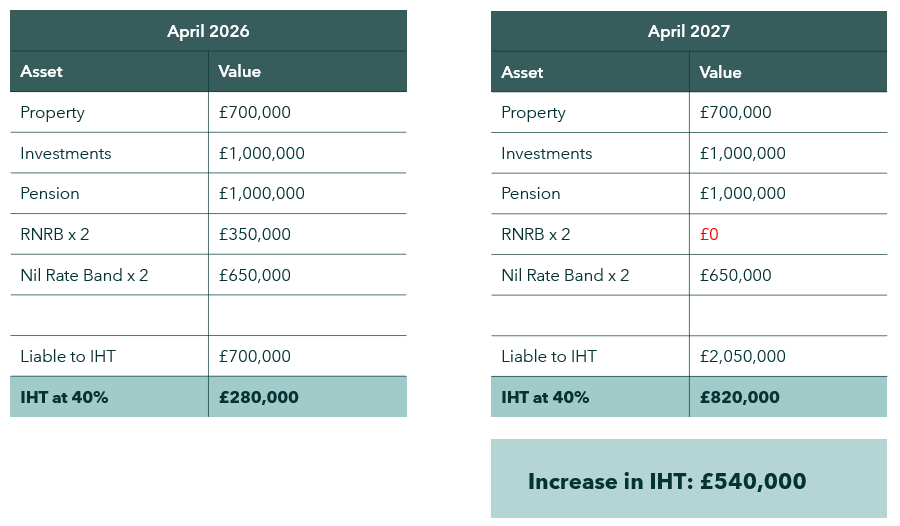
Using a simple case study, Dan illustrated how these changes could affect a typical financial planning client that has been building wealth in their pension fund under the current rules for succession planning.

In the example shown, an estate that may currently result in an inheritance tax liability of £280,000 could increase to £820,000 after 6 April 2027, under the new rules – a difference of £540,000. This is because the value of the estate is now above £2m, triggering the reduction of the Residence Nil Rate Band (RNRB), which is £1 reduced for ever £2 over £2m).

While this is purely illustrative, it highlights how important it is to review planning sooner rather than later.


The £2 million Residence Nil Rate Band (RNRB) Cliff Edge

For illustrative purposes only. Based on our current understanding of UK pension legislation law, tax law and HM Revenue and Customs’ practice April 2026.


Inheritance Tax Planning opportunities

There are a range of established strategies that can help manage and mitigate IHT exposure. These may include:

  • Gifting or spending during lifetime
  • Using trusts as part of estate planning
  • Considering Business Relief investments
  • Reviewing income options such as annuities
  • Putting appropriate protection in place

An important theme from the session was the need to balance planning for the future with maintaining control and flexibility in the present. Many of the strategies discussed can help reduce the value of an estate for tax purposes, while still supporting income needs and access to capital during your lifetime.

Regular reviews are also key. As legislation evolves and personal circumstances change, ensuring that arrangements remain aligned to your long-term objectives can help avoid unintended consequences and provide greater confidence over time.


A joined-up approach

Alongside Dan’s session, we were joined by our partners:

Together, this reinforced the value of a coordinated approach, bringing together financial planning, legal expertise, and protection to support long-term outcomes, all coordinated by Wren Sterling Financial Planners.

What next?

If you would like to discuss how these changes may apply to your own situation, we’re here to help you navigate them with clarity and confidence. Get in touch.

We are also planning to host further events later in the year and will share more details, including the date and venue, in due course.

If you would like to register your interest for either our North of England, Scotland or virtual briefings to be first on the list for a place, please complete our short form below.

Important information

This is not advice or a personal recommendation, as it does not take your individual circumstances into account.

All references to taxation are to UK taxation and are based on our current understanding of UK law and HM Revenue & Customs’ practice as at April 2026 and are subject to change. We are not providing legal or tax advice and recommend that you obtain independent tax and legal advice tailored to your situation. The Financial Conduct Authority does not regulate Inheritance Tax (IHT) planning, tax advice, estate planning or advice on Wills and Trusts.

Daniel Payne
About the Author

Dan is a Chartered Financial Planner and has been a financial adviser for almost 25 years before joining Wren Sterling in October 2025.