Client Login




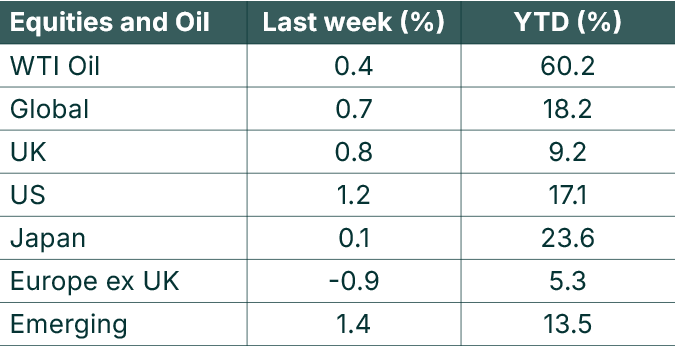
Global share markets finished a choppy week higher, with gains broadening beyond recent leaders as defensive sectors regained some ground.
This week, investor attention turns to the US earnings season, where analysts expect year-on-year growth of just under 30%. A busy economic calendar provides the other key focus, with Wednesday’s US inflation release likely to matter most for markets.
Last week
• Global equity markets rose by 0.7% and today marks the 4-year anniversary of this bull market
• UK shares rose by 0.8%: boosted by the energy sector
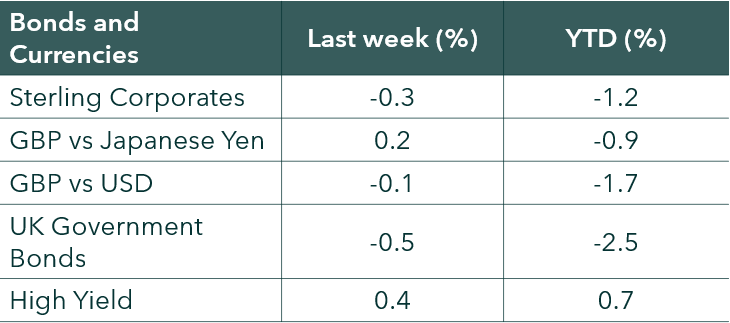
• Bond yields continued to track higher; putting further pressure on government bonds
• Credit spreads tightened which saw high yield markets outperform
This week
-Investor attention will focus on the US earnings season and a busy economic calendar, including US inflation and housing data, Chinese inflation and trade figures, and UK GDP.
-US earnings season sees reports from the big banks, with Goldman Sachs, Wells Fargo, JP Morgan, Bank of America and Morgan Stanley all reporting this week. Analysts, as per FactSet, are estimating 29.6% year-on-year earnings growth for Q3 2026 for US companies.
-US existing home sales data is released on Tuesday along with US inflation on Wednesday and US retail sales on Thursday.
-UK growth data (GDP) for August is released on Thursday.
-Chinese trade and inflation data are released on Tuesday.
Source: Bloomberg. Currency: GBP.
More details
Today marks the fourth anniversary of this equity bull market, during which global equities have risen by just over 100%. US equities have done most of the heavy lifting, as might be expected given that they represent around 70% of the global equity market. Importantly, close to 70% of the US market’s advance has come from earnings growth, with valuation expansion accounting for the remaining 30%. The US market’s forward 12-month price-to-earnings ratio is now 19.1 times. That is not table-thumping cheap, but it is below the five-year average and around four multiple points—or roughly 15%—lower than a year ago.
Last week saw the global equity market rise by about 0.7%, with US shares leading the way; up 1.2%. Gains within the US market last week were driven by Energy, Staples, Healthcare and Utilities, with the technology sector (c40% of the US market) pausing for breath after a strong run.
UK shares rose by around 0.8% last week, taking the year-to-date return to just over 9%. The market has benefited from its near-11% weighting to energy, a sector that is up around 40% this year, but corporate activity has also provided meaningful support. UK public M&A deal values have reached £75bn so far this year, according to White & Case LLP—close to double the £38.2bn recorded across the whole of 2025. In addition to this, c£45bn of share buybacks are expected this year.
Bond markets continued to dominate headlines last week. The 10-year gilt ended the week yielding 5.44%, having reached 5.48% on Thursday—its highest level since 2007—while the 30-year gilt yield closed at 5.95%. The rise in yields pushed 10-year government bond indices down by around 0.5%, taking their year-to-date return to -2.5%. Although longer-dated bonds now offer an attractive real yield (10-year gilts now offer a real yield of c2.3% which is their highest level in more than 20 years), we continue to prefer the shorter-dated part of the market, where yields are close to 4.9% and interest-rate risk is lower.
Within credit markets, high yield spreads narrowed last week, which helped boost these assets. High yield spreads (US) closed out the week at 3.08%. This is still a historically tight level, but some way above the 2.6% that we reached during the summer.
Minutes from the US Federal Reserve’s September policy meeting were released last week. They were closely watched because September brought the first interest-rate increase under new Fed Chair Kevin Warsh, taking the upper bound of the policy rate to 4%. Bond futures then moved quickly to price in as many as four further increases over the following 12 months. The minutes offered little additional clarity and did not prescribe a fixed path. Fed Governor Christopher Waller echoed that message, commenting that there “is some flexibility about when those hikes will occur”. By the end of the week, bond futures were pricing in three further increases over the next year, with the next expected at the 9 December meeting.
The Bank of England next meets on 5th November, when it is expected to raise interest rates by 0.25 percentage points to 4%. The meeting falls a week after the UK Budget on 28th October, so the decision is likely to be influenced by the fiscal announcements made there.
The value of investments and the income from them can go down as well as up and you could get back less than you invested. Past performance is not a reliable indicator of future performance.
The content of this article is not intended to be or does not constitute investment research as defined by the Financial Conduct Authority. The content should also not be relied upon when making investment decisions, and at no point should the information be treated as specific advice. The article has no regard for the specific investment objectives, financial situation or needs of any specific client, person, or entity.