

 Client Login



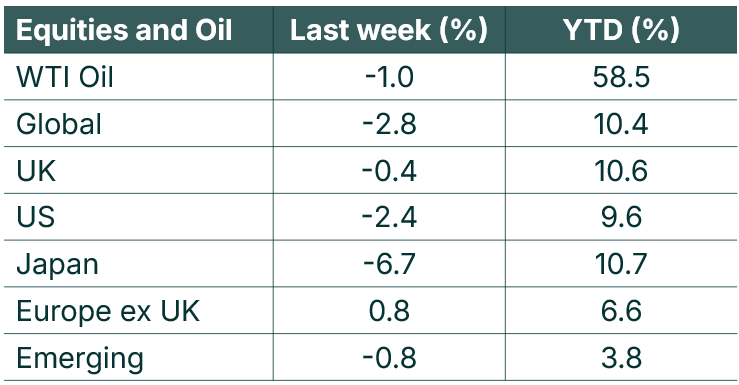
We have said for a while now that although we aren’t calling the end of the AI trade, we do think exposure needs close management. If we have learned anything over the past couple of months, it’s that the one-way traffic of the beta trade is likely over, and at the very least we are starting to see dispersion across the trade.
Another noisy week epitomises this. It’s not clear how much of the news flow has driven the price action, as AI was under pressure before this week, but prevailing rhetoric suggests the Blue Wave might further exacerbate this.
Much of these developments support our positioning rationale. Despite all this positivity in the news flow, the market still suffered a serious rout, so it’s worth unpacking what’s going on, and how it ties with our positioning.
Last Week:
- Apple, Panatir, and McDonalds all beat earnings expectations, along with AMD, and ARM Holdings.
- The Bank of England Monetary Policy Committee hiked rates to kickstart its hiking cycle this week.
- The US midterm elections saw the Democrats take control of the House and Senate.
- US PMI data beat forecasts, along with labour data in JOLTS, initial claims, and non-farm payroll employment.
Corporates delivered strong earnings which mattered little amongst the volatility. Apple posted record revenue and profit, along with ARM, and Palantir grew commercial revenue faster than government for the first time ever. McDonalds was rewarded with a 6% day for its results, and although AMD also beat expectations, it still sold off 17%.
The MPC vote passed 8-1 to hike by 25bps to 4%. The only dissenter wanted to raise by 50bps as the Bank forecasts inflation to hit 5% in the second quarter of next year. The driver is undoubtedly energy, but something to consider is the second-round effects. Its common wisdom that monetary policy has little impact on the international energy market, but it’s still a cost to companies who are trying to manage their margins. Their defence against rising costs is increasing prices, which is of course, inflationary, and this is what the BOE is aiming to fight.
In the US midterms, the Democrats took control of the House of Representatives, and the Senate, which controls US legislature. This makes life difficult for the President as he loses the backing of these arms of government. The shift in power likely has little tangible impact on inflation directly, but it does mean that tax cuts and fiscal spending are hampered. Of more concern is perhaps the volatility of the President himself. He still wields executive power with reckless abandon, so without the House and Senate to support him, he may become even more unpredictable and lash out using this avenue.
It’s hard to see how the conflict in Iran resolves under this new shape of government too. Regardless of how military action is decided, the US cannot simply row back what’s been done. We might see a more considered approach to US intervention, but it’s unlikely that the oil price will fall without a resolution which still looks a long way off.
From an AI perspective, the Democrats may try to impose more stringent regulation, but the President retains power of veto, so its unlikely much changes for the rest of this administration. Its also not in the interest of the Democrats to stand in the way of growth, particularly if they want to win the next election. Our base case is that this adds noise to the AI rhetoric with marginal fundamental change for the foreseeable future. That said, as mentioned above, there are already fault lines appearing which need no help from the government in getting wider and deeper. We still think diversification is key and we retain this discipline across all of our portfolios.
Economic data in the US has been strong. The aggregate PMIs themselves are not the full story, however. Although services and manufacturing remain in the mid-50s and beat forecasts, input prices remained in the 70s. Simply put, higher input prices signal higher inflation.
Further fuel to the inflation fire is from employment data. JOLTS (job openings and labour turnover) was strong. New job postings were above forecast and layoffs remained low; initial jobless claims were below previous and expectations of an increase; and non-farm payrolls smashed expectations with previous months also revised higher.
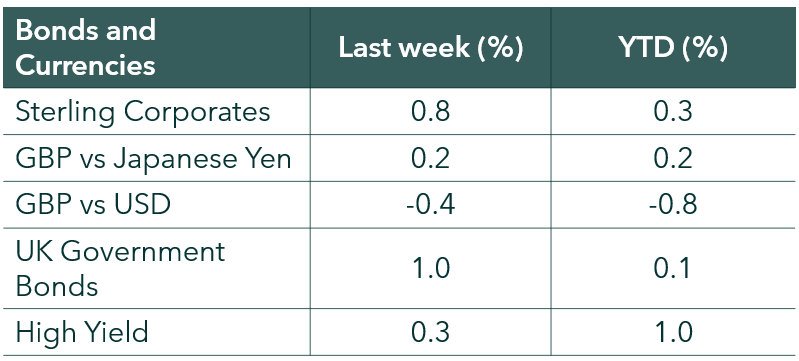
Developments either side of the pond give us further comfort in our portfolio positioning. Rate hikes and higher inflation in the UK continue to put upward pressure on the yield curve, and despite potential issuance in the US abating somewhat, the inflation problem appears as strong as ever. Government bonds have done what they should do when markets experience volatility caused by growth concerns, and have provided a nice hedge. However, they are less effective when the market is worried about inflation, and it feels like this will take centre stage again in due course.
We expect pure-passive investing to continue to struggle as market cap weighted equities and market duration bonds bear the brunt of these risks. We remain short duration, insulated from rising rates and less reliable portfolio construction, getting as much yield as possible for as little duration, as well as more diversified in our equity components.
Next Week:
• US CPI is on Tuesday, which surprised to the upside last month and is forecast a tenth higher still this month at 3.7%; core is forecast to fall by the same margin to 2.5%, however.
• US PPI is on Friday, which also surprised last month by a wider margin; it is forecast to fall back two tenths to 6.1% this time.
o The market reaction was strong after both surprised last time, so brace for something similar here with already heightened volatility.
• UK GDP is on Wednesday and expected to accelerate from 1.4% to 1.7%.
• Cisco and Applied materials report on Thursday which could move the market if they disappoint, but they could also get lost in a continued sell off.
The value of investments and the income from them can go down as well as up and you could get back less than you invested. Past performance is not a reliable indicator of future performance.
The content of this article is not intended to be or does not constitute investment research as defined by the Financial Conduct Authority. The content should also not be relied upon when making investment decisions, and at no point should the information be treated as specific advice. The article has no regard for the specific investment objectives, financial situation or needs of any specific client, person, or entity.