Client Login



Weekly Round-Up, 7th September
It was a sideways week for most major equity markets with very modest gains or losses ranging from –10 bps (UK) to +30 bps (Global and US) with emerging markets sitting in the middle. The two exceptions were Japan which gained +1.7% and Europe which lost –0.5%.
Last week
• Energy prices and the predicted path for monetary policy were the main drivers over the week.
• WTI oil prices surged 9.4% over the week due to renewed US-Iran tensions.
• Strong US labour market data reinforced the view that interest rates could increase at the next Fed meeting, driving up Treasury yields.
• Inflation concerns re-emerged, particularly through higher energy prices, this was a headwind for net energy importers such as the major European markets.
This week
• The two most influential releases are likely to be the following:
• ECB Rate Decision (Thursday)
Markets are widely expecting the European Central Bank to deliver another interest rate hike. The focus will be less on the decision itself and more on any guidance regarding the pace of future tightening and the outlook for growth and inflation.
• US CPI (August) (Friday)
This is the week’s most important data release. Following Kevin Warsh’s hawkish comments at Jackson Hole, markets have increased the probability of a September Fed rate hike to around 65%. A stronger-than-expected inflation reading would likely reinforce expectations of further policy tightening. US producer price inflation (PPI) is released the day before.
Other Economic Data
Monday – Japan Q2 GDP (final estimate)
Tuesday – China August trade data
Wednesday – China August inflation data
Thursday – US PPI (August), ECB policy decision
Friday – UK GDP (July), UK trade balance, UK industrial production, UK manufacturing production
Earnings Releases
• Adobe and Oracle (Thursday) – Both reports will be closely watched for indications of ongoing enterprise spending on software, cloud infrastructure and AI-related projects. Their outlook statements could influence sentiment across the broader software and AI ecosystem.
• TSMC (Thursday) – releases monthly sales figures on Thursday. While not a full earnings update, the data provides an indicator of demand across the AI hardware supply chain and remains an important barometer for technology markets globally, particularly in Taiwan, Korea and the wider semiconductor sector.
• Rounding out a week of influential technology company releases: on Tuesday Computacenter will release its results. The stock joined the FTSE 100 index in June and shares rose 23.3% during August on expectations that spending by hyperscaler cloud providers is accelerating. This week’s results should help determine whether the recent share price strength is supported by underlying fundamentals or is primarily momentum.
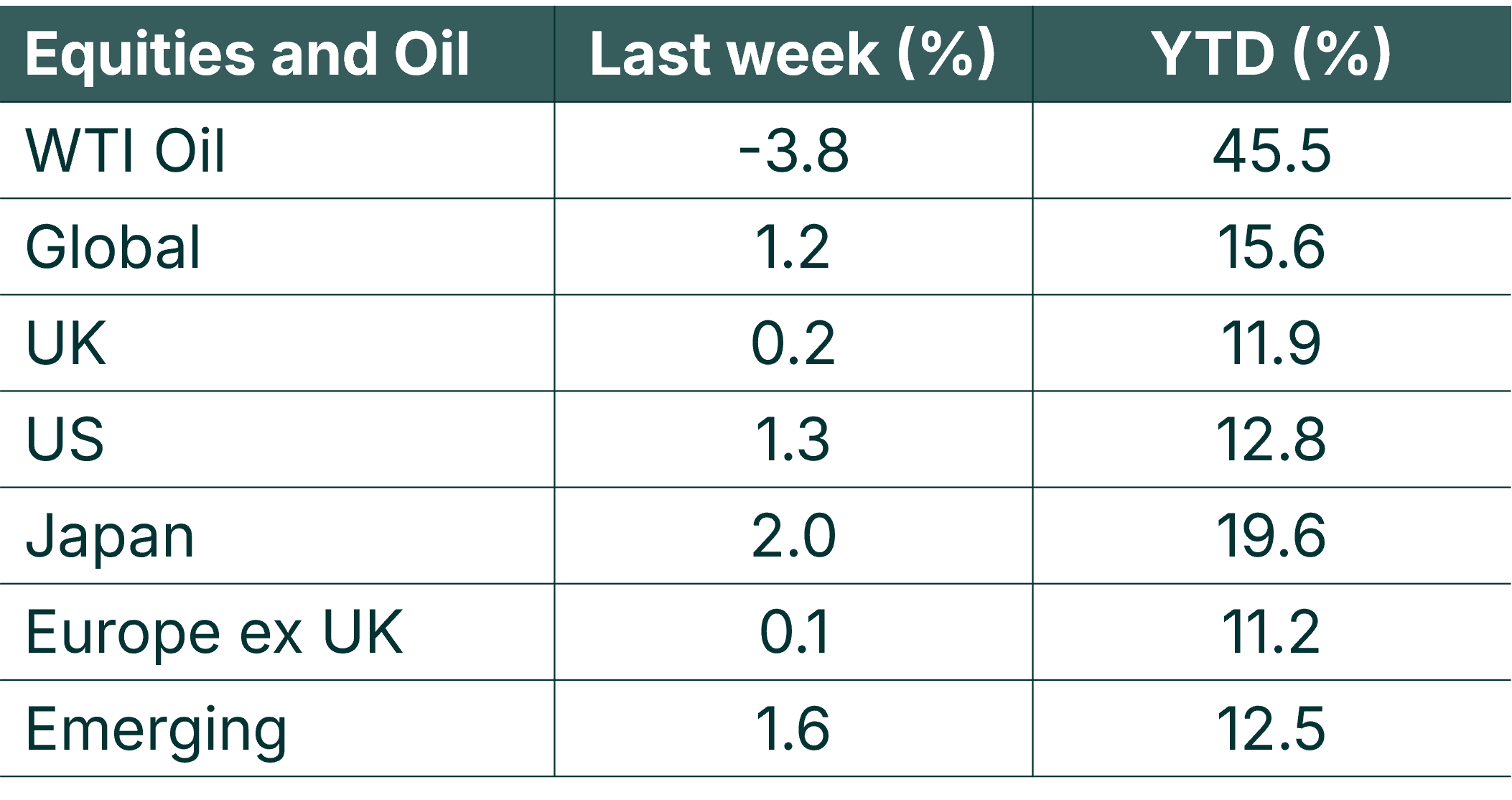
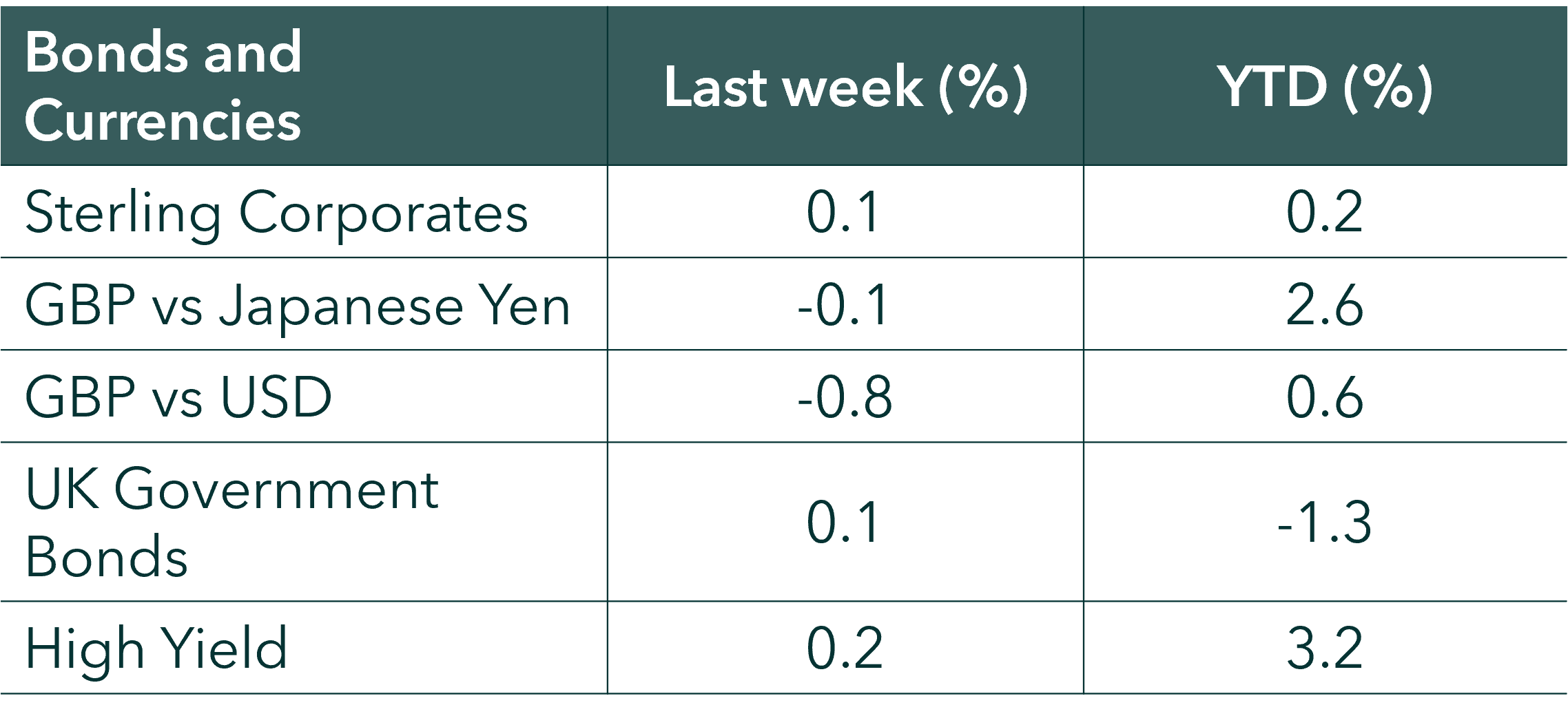
Source: Bloomberg. Currency GBP.
More details
August’s labour market report pointed to renewed resilience in the US economy. Payrolls increased by 162,000, nearly three times economists’ forecasts and the largest monthly gain in five months, while the unemployment rate held steady at 4.1%. This represented a sharp improvement from July’s revised increase of 21,000 jobs.
Following Friday’s stronger-than-expected jobs report, financial markets increased the likelihood of a Federal Reserve rate rise at its 16 September meeting. CME FedWatch data showed futures markets pricing in a roughly 58% chance of a 0.25% increase in the Fed’s benchmark rate, compared with a 42% probability of rates remaining unchanged. This marked a notable shift from the previous day, when market expectations were evenly split between a rate hike and no change.
US Treasury yields continued to move higher during the week, with the 2-year and 10-year Treasury yields reaching year-to-date highs of 4.39% and 4.80%, respectively, on Tuesday before easing modestly. Further along the curve, the 30-year Treasury yield finished Friday at 5.24%, just below its recent peak of 5.31% and close to its highest level in approximately 20 years.
Within the UK market, performance was mixed across sectors. Computacenter was among the standout performers, extending recent gains amid continued optimism around hyperscaler cloud spending and AI-related infrastructure demand. Vodafone, Kingfisher, M&G and Associated British Foods were also among the stronger performers as investors rotated towards more value-oriented and defensive areas of the market.
On the downside, growth-oriented stocks came under pressure as higher bond yields weighed on valuations. Experian, Rightmove, RELX, 3i Group and Sage were among the notable fallers during Friday’s trading, reflecting some profit-taking in sectors that have performed strongly for much of the year.
Domestic developments also influenced sentiment. Reports that the government is considering potential fiscal measures, including possible windfall taxes on banks and energy companies, created some uncertainty for financial stocks. However, economic data remained broadly constructive, with UK new car registrations rising 13.7% year-on-year in August, extending a run of nine consecutive months of growth.
The value of investments and the income from them can go down as well as up and you could get back less than you invested. Past performance is not a reliable indicator of future performance.
The content of this article is not intended to be or does not constitute investment research as defined by the Financial Conduct Authority. The content should also not be relied upon when making investment decisions, and at no point should the information be treated as specific advice. The article has no regard for the specific investment objectives, financial situation or needs of any specific client, person, or entity.