Client Login




Weekly Round-Up, 5th October 2026
Global equity markets fell by -0.50% last week. Whilst the US and Japanese equity markets were broadly flat, the UK, Europe and Emerging Markets all declined. Bond markets were mainly flat, excepting high yield which fell c.1%. On the positive side, oil prices fell by -1.6% as the G7 announced some strategic fuel reserve releases.
Last week
• The US labour market data disappointed, with only 29,000 jobs added in September versus expectations of 80,000-90,000 and prior months revised lower. Unemployment increased moderately to 4.2% from 4.1%.
• US inflation data was more encouraging, with the Fed’s preferred inflation measure (PCE) coming in below expectations. Headline PCE was 3.4% and core PCE slowed to 3.0%.
• US technology stocks continued to drive US stock market returns.
• Eurozone inflation accelerated to 3.8%, above expectations, increasing the likelihood that the ECB will maintain restrictive monetary policy. France, Spain and Italy all reported stronger inflation readings, while concerns over French public finances added further pressure to markets.
• Chinese equities fell as investors were disappointed by Beijing’s latest stimulus measures, which negatively influenced emerging markets indices.
• Japanese equities were mixed, with AI and semiconductor-related companies driving gains while broader markets weakened amid expectations of further Bank of Japan policy tightening.
This week
• US ISM Services PMI (Monday) this data will give an indication of US economic momentum.
• FOMC Minutes (Wednesday) will give further clues on whether the Fed is likely to pause following the weak September payrolls report.
• PepsiCo earnings (Thursday) and Delta Air Lines earnings (Friday) will provide important indicators of US consumer spending trends.
• The UK data calendar is relatively quiet next week, with PMI surveys and housing-market indicators from Lloyds providing the main domestic updates.
• Chinese markets remain closed for a National Day holiday at the start of the week; trading will resume on Thursday after “Golden Week”.
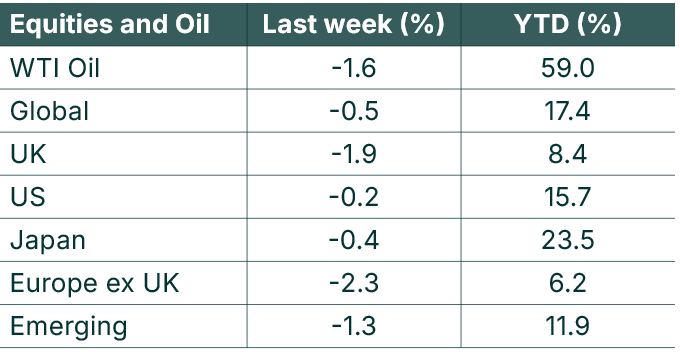
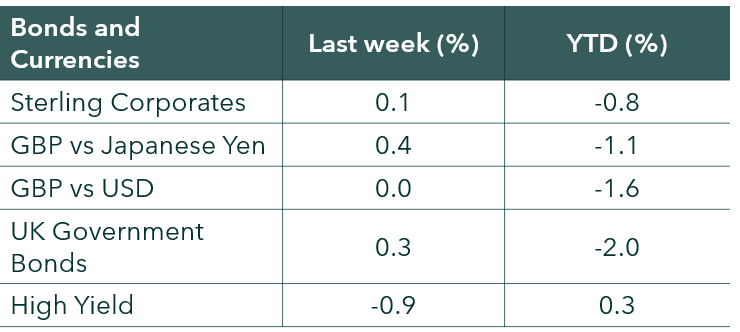
Source: Bloomberg. Currency: GBP.
More details
• US equity markets were mixed as investors weighed weaker economic data against the prospect of a less aggressive Federal Reserve. September payrolls increased by just 29,000, well below expectations, while unemployment edged up to 4.2%. While labour market conditions are softening, inflation remains persistent, with core PCE inflation holding at 3.0%. Second-quarter GDP was revised up to 2.2%, highlighting continued resilience in consumer spending and investment. Treasury yields remained elevated, although expectations of further near-term interest rate increases eased following the weaker jobs report.
• UK equities weakened as a sharp rise in gilt yields weighed on investor sentiment, pushing the FTSE 100 down around 2% over the week. Economic news was more encouraging, with Q2 GDP revised higher to 0.5%, confirming the UK as the fastest-growing G7 economy in the first half of 2026. However, attention remained focused on the 28 October Budget, with investors concerned about government borrowing requirements and their impact on bond yields.
• European markets struggled as higher inflation, rising bond yields and elevated energy prices weighed on sentiment. Eurozone inflation accelerated to 3.8%, exceeding expectations and increasing the likelihood that the ECB will keep monetary policy restrictive. France, Spain and Italy all reported firmer inflation readings, while concerns over French public finances added to market uncertainty.
• Japanese equities were mixed, with AI and semiconductor-related companies outperforming while the broader market came under pressure from expectations of further Bank of Japan policy tightening. Tokyo core inflation rose to 2.7% year-on-year from 1.8% in August, reinforcing the case for higher interest rates. However, signs of division among policymakers over the pace of future tightening helped support risk sentiment.
• Chinese equities declined as investors were left underwhelmed by Beijing’s latest stimulus measures. While policymakers announced support for housing, lending and investment, markets questioned whether the measures would be sufficient to address weak domestic demand and longer-term structural challenges. Economic data improved modestly, with both manufacturing and services PMIs returning to expansion territory, suggesting activity may be stabilising.
• Anthropic, the developer of Claude AI, has begun preparations for what could become one of the largest IPOs in history, with reports suggesting a valuation of up to $2 trillion. The company has achieved exceptional revenue growth, with 2025 revenues reportedly reaching approximately $4.6 billion, but continues to generate significant losses as it invests heavily in computing infrastructure and AI development. Investors will be watching closely to see whether rapid AI-driven revenue growth can justify the substantial infrastructure spending and losses required to build next-generation AI models.
The value of investments and the income from them can go down as well as up and you could get back less than you invested. Past performance is not a reliable indicator of future performance.
The content of this article is not intended to be or does not constitute investment research as defined by the Financial Conduct Authority. The content should also not be relied upon when making investment decisions, and at no point should the information be treated as specific advice. The article has no regard for the specific investment objectives, financial situation or needs of any specific client, person, or entity.