Client Login



Key takeaway: Resilient economic growth continues to support equity markets, but it is also keeping bond yields elevated. For investors, this creates a more balanced backdrop: stronger growth supports corporate earnings, while higher yields improve prospective bond returns but can create short-term price volatility.
Global equities rebounded strongly last week, delivering their best performance since early August as US technology shares and a stronger US dollar lifted returns for UK investors. Robust business surveys – particularly in the US – reinforced the picture of a healthy US economy. That stronger growth outlook supported equities but pushed bond yields higher, weighing on bond prices.
This week, US inflation and jobs data—due on Wednesday and Friday respectively—will be the key focus. Both releases could materially influence bond-market expectations for the future path of US interest rates.
Last week
• Bond yields rose which put pressure on bond prices
• Economic growth indicators were strong – notably in the US
• Global stock markets had their best week since early August
• Oil prices fell, which helped investor confidence
This week
Investor attention will focus on three releases: US Core PCE inflation on Wednesday, US nonfarm payrolls on Friday and finalised UK second-quarter growth figures on Wednesday.
• US Core PCE inflation data is released on Wednesday, followed by the monthly US jobs report, including nonfarm payrolls, on Friday. Core PCE is the Federal Reserve’s preferred inflation measure. Together, the releases address both parts of the Fed’s dual mandate—price stability and maximum employment—and will therefore be important ahead of its next meeting on 28th October.
• Finalised UK growth numbers are released for the 2nd quarter on Wednesday – with economists (as surveyed by Bloomberg) expecting a 1.2% growth rate year-on-year.
• Eurozone inflation is released on Friday.
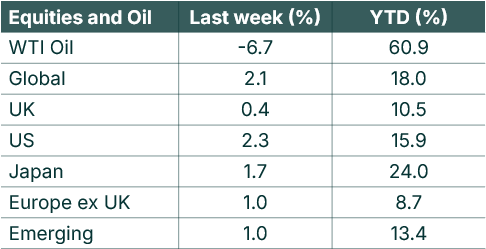
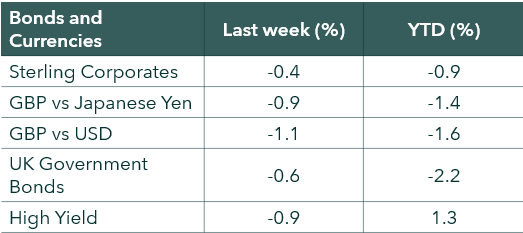
Source: Bloomberg. Currency: GBP.
More details
Higher bond yields dominated
Bond yields dominated last week, with government bond yields in both the UK and the US reaching their highest levels since the summer of 2007. Encouragingly for investors, the move was driven more by stronger expectations for future economic growth than by higher inflation expectations. This matters because it represents a rise in “real yields”: the return investors can expect after adjusting for inflation.
Investors buying US sovereign bonds can now expect to make 2.4% over and above inflation on short-term bonds (the highest return in approx. 2 years) and 2.7% on 10-year bonds – this is the highest level since 2007.
Strong growth drives rise in bond yields
Strong economic data – particularly in the US – has been a key driver of recent market moves. Last week’s S&P Global Purchasing Managers’ Index surveys were robust across the board, with US business activity accelerating at its fastest pace in more than five years. This is consistent with other indicators, including the Atlanta Fed’s GDPNow estimate that the US economy is growing at an annualised rate of 5% in the third quarter. The equivalent UK PMI data also remained in expansionary territory.
Strong US economic data drives strong dollar
The US dollar rallied against this backdrop, rising by more than 1% against the pound to reach its strongest level in nearly three months. This boosted the sterling value of UK investors’ overseas holdings, particularly global equity allocations, because the US represents approximately 70% of the global equity market.
Global equity markets posted their best week since early August
Global equity markets rose by 2.1% in sterling terms last week, supported by US equity strength—particularly in technology—and a stronger US dollar. The US technology sector gained 4.4%, taking its month-to-date return to 7.1% and its year-to-date return to 31.7%. Meta Platforms was among the sector’s strongest performers, rising by 14.1% as investors saw signs that AI investment could become a revenue opportunity rather than simply a cost. Meta chief Mark Zuckerberg also unveiled the company’s new handheld AI assistant, Muse. Despite a 30% rise over the past month, Meta trades on a forward 12-month price-to-earnings multiple of 24.7x after its valuation, like those of several large US hyperscalers, had fallen earlier in the year.
Lower oil prices
Oil prices fell last week, with WTI crude ending the period below $100 a barrel. The decline followed talks between the US administration and Iran, which raised hopes of a peace agreement and reduced the geopolitical risk premium embedded in oil prices.
The value of investments and the income from them can go down as well as up and you could get back less than you invested. Past performance is not a reliable indicator of future performance. The content of this article is not intended to be or does not constitute investment research as defined by the Financial Conduct Authority. The content should also not be relied upon when making investment decisions, and at no point should the information be treated as specific advice. The article has no regard for the specific investment objectives, financial situation or needs of any specific client, person, or entity.