Client Login



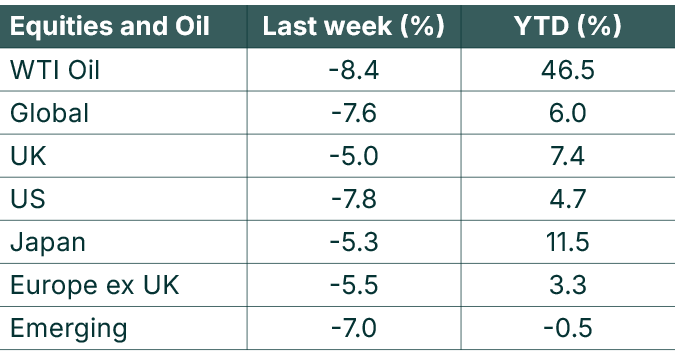
Global stock markets fell sharply last week, led by weakness among technology companies, with index heavyweight Nvidia down more than 20%. Bond markets rallied during the equity sell-off, with government bonds performing particularly well.
Weeks like this are uncomfortable, but they are also an important reminder of why diversification matters. The concentration inherent within major equity indices has been one of the risks we have highlighted for some time, and one we have deliberately sought to manage within our clients’ portfolios.
Importantly, however, market prices have moved much more dramatically than the fundamental backdrop. The US equity market now trades on around 17x forward earnings, approximately 25% cheaper than a year ago, while corporate earnings are growing at more than 30% year-on-year and that growth is broadening beyond the Magnificent Seven.
Corrections are a normal feature of equity investing. We don’t know whether this one is finished, but we do think there are good reasons not to extrapolate one very difficult week indefinitely.
Last week
• Global markets fell by 7.6% – their worst week since Liberation Day
• US technology stocks drove much of the downward price pressure
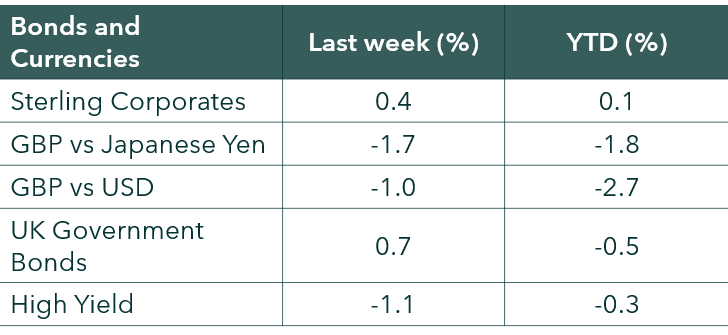
• Bond markets provided some ballast as investors sought safer assets
• Global equities ended the week trading on their cheapest forward valuation in more than three years.
Source: Bloomberg. Currency: GBP.
This week
• Markets are likely to remain sentiment-driven during a holiday-shortened US trading week, with US markets closed for Thanksgiving on Thursday and closing early on Friday.
• Business survey data is released today for both the US and UK, with both expected to remain in expansionary territory.
• The Federal Reserve’s preferred gauge of underlying inflation, core PCE, is released on Wednesday and will be important for expectations around the future path of US interest rates
More detail
Global stock markets fell by 7.6% last week. In GBP terms, the global equity market is now 9.5% below its recent high, with much of the decline driven by technology. The technology sector fell 11.4% last week alone and is now around 25% below its early-October level.
Bonds did what investors would hope they might do during a difficult week for equities. UK government bonds returned 0.7%, while US Treasuries gained 1.3%.
Interest-rate expectations also shifted. Markets entered the previous weekend pricing around three further Federal Reserve rate rises over the coming six meetings, but last week’s sell-off saw that fall to around two.
That came despite minutes from the Federal Reserve’s latest meeting showing support for further tightening to bring inflation back towards its 2% target.
In other words, markets are not currently expecting the Federal Reserve to ride to the rescue with rate cuts. They have simply become less aggressive in their expectations for further rate rises.
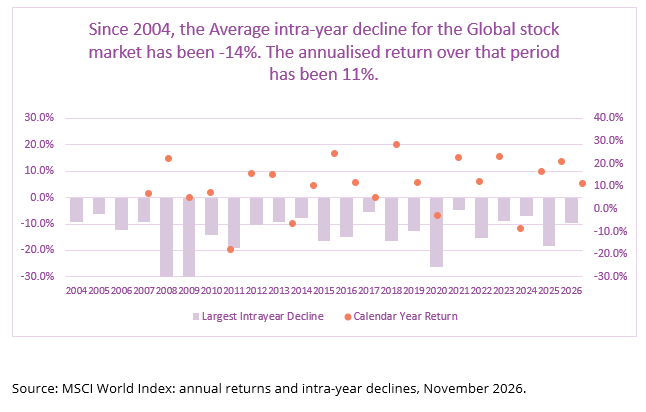
Market corrections such as the one we are experiencing can be unsettling. They are also a normal feature of investing – as the chart below shows
We think there are 4 important things for investors to keep in perspective.
1) Market corrections are uncomfortable, but normal
Equity markets rarely move upwards in a straight line. In any given year, it is normal for the market to have several dips of 5% or more, with about 1 correction of 10% or more on average per year, with a severe correction (greater than 15%) about once every 2 years. [1]
[1] Source: Edward Jones using S&P 500 index data from 1928 to 2024.
2) Valuations have fallen sharply, whilst earnings remain strong
This is perhaps the most important feature of the current sell-off.
The forward P/E ratio of the US equity market has fallen to 17.1x, its cheapest valuation since October 2023. That is below its five-, ten- and 15-year averages and around 25% cheaper than it was a year ago.
Technology, which has borne the brunt of recent selling, now trades on a forward P/E ratio of 16.3x, very close to the 16.1x reached during the March 2020 Covid crash.
But this valuation reset has not been accompanied by a collapse in corporate profits.
Quite the opposite.
US earnings are currently growing at more than 30% year-on-year, and importantly this is no longer simply a Magnificent Seven story.
For the first time since 2022, the other 493 companies in the S&P 500 are growing earnings faster than the Magnificent Seven. Earnings across the broader market have also surprised positively, while the Magnificent Seven collectively fell short of expectations.
Looking into 2027, consensus still expects strong double-digit earnings growth, but importantly that growth is expected to broaden further, with significantly less reliance on AI and Technology to drive the overall earnings picture.
That distinction matters. This has so far been much more of a valuation correction than an earnings correction.
3) The economic backdrop remains reasonably solid
There are clearly risks to the economic outlook, but the underlying US economy does not currently resemble one entering a deep contraction.
• The Atlanta Fed GDPNow model has the US economy growing at 3.2%
• US and UK labour markets remain relatively robust
• Business sentiment surveys remain strong and are in “expansionary” territory
The relationship between markets and economies is never straightforward, and strong economic data does not guarantee rising stock markets.
But today’s market weakness is not occurring against the sort of collapsing economic backdrop that has characterised some of the most severe bear markets in history.
4) Credit markets are giving us an important signal
Credit is one area we are watching particularly closely.
Investment-grade corporate credit spreads remain around their five-year average levels, suggesting that markets are not currently signalling widespread concern about corporate solvency or balance-sheet health.
There has, however, been considerably greater pressure among lower-quality high-yield borrowers.
That deserves attention, but there is an important structural difference between today’s high-yield market and previous credit cycles.
CCC-rated and lower bonds now account for only around 8% of the US high-yield index, compared with roughly the mid-teens during the 2015–16 credit cycle and around 20% or more around the global financial crisis.
The weakest credits are undoubtedly under pressure. But they represent a considerably smaller proportion of the overall high-yield market than they did during previous periods of significant credit stress.
What about central banks?
Neither the Federal Reserve nor the Bank of England currently appears likely to ride immediately to the market’s rescue.
Inflation remains above target, and both central banks are expected to raise interest rates again in December.
There was, however, an important change last week. Markets reduced their expectations for Federal Reserve tightening from around three additional rate rises over the next six meetings to approximately two.
Central banks therefore remain constrained by inflation today, but they retain significant policy flexibility should the economic backdrop deteriorate materially.
And what about AI?
Artificial intelligence has inevitably been at the centre of the recent market volatility.
AI laboratory Anthropic completed its highly anticipated IPO last week. The offering was reportedly more than six times oversubscribed and priced at $83 per share, above its original $70–$78 marketing range. Despite volatile trading after listing, the shares finished the week above their IPO price.
That doesn’t settle the debate around AI valuations or the enormous amounts of capital being committed to AI infrastructure.
It does, however, suggest that investor appetite for high-quality AI assets has not disappeared altogether.
Nvidia has been right in the eye of the storm.
The company delivered another set of exceptionally strong results last week, with both earnings and revenues continuing to grow at extraordinary rates.
Yet Nvidia’s share price has fallen by around 47% since early October, wiping approximately $2.75 trillion from its market capitalisation.
To put that figure into a UK context, that is roughly equivalent to losing the value of ten HSBCs.
The speed of that repricing is remarkable.
Nvidia now trades on less than 9x forward earnings on some consensus measures, representing an extraordinary compression in its valuation and its cheapest level in at least 15 years.
A low valuation doesn’t guarantee that a share price will rebound, of course. Earnings expectations can change, particularly in an industry evolving as rapidly as AI.
But it illustrates just how dramatically investor expectations have reset in a matter of weeks.
The importance of diversification
The sell-off of recent weeks reinforces something we have discussed for some time.
The extraordinary concentration within major market-cap-weighted equity indices has been one of the most significant risks facing investors.
For that reason, we have deliberately sought to manage this concentration within client portfolios rather than simply accepting the weights dictated by the largest indices.
That has included exposure to diversifying geographical markets such as the UK, alongside equally weighted US equities as a complement to broad-market US exposure.
This has mattered during the recent sell-off. Our equally weighted US equity exposure is currently around 9% ahead of its market-cap-weighted equivalent quarter-to-date.
Diversification does not mean avoiding market falls altogether. Nor will every diversifying asset outperform during every period.
Its purpose is to avoid becoming dependent on one country, sector, theme or handful of companies for investment returns.
Last week’s market moves provided a powerful reminder of why that matters. (2)
(2) Source: Bloomberg. November 2026.
Our view
There is no point pretending that a 7.6% weekly fall in global equities is insignificant, nor can anybody know whether the current correction has run its course.
But neither do we think the headlines tell the whole story.
Prices have fallen sharply and valuations have reset, particularly in technology. Yet corporate earnings remain strong and are broadening beyond the handful of companies which have dominated markets in recent years. Economic activity remains relatively robust, investment-grade credit markets remain orderly, and bonds have once again demonstrated their diversification benefits.
The uncomfortable truth about investing is that some of the best opportunities are created when markets feel at their worst. The strongest days in equity markets have historically tended to occur close to the weakest ones, which makes trying to sell before the bad days and buy back before the good ones extraordinarily difficult.
Successful investing therefore doesn’t require us to identify the bottom.
After the moves of recent weeks, US equities are around 25% cheaper on forward earnings than they were a year ago, technology is trading close to its Covid-crash valuation, and earnings expectations remain strong. None of that tells us what markets will do tomorrow or next week. But for long-term investors, the prospective returns available today look more attractive than they did before the sell-off.
The temptation after a week like this is to wait until things feel better. The problem is that, by the time they do, markets often already are.
The value of investments and the income from them can go down as well as up and you could get back less than you invested. Past performance is not a reliable indicator of future performance.
The content of this article is not intended to be or does not constitute investment research as defined by the Financial Conduct Authority. The content should also not be relied upon when making investment decisions, and at no point should the information be treated as specific advice. The article has no regard for the specific investment objectives, financial situation or needs of any specific client, person, or entity.