Weekly Round Up, 21st September 2026

Emma Matthews

Weekly Round-Up – 21st September 2026


Last week, global markets were shaped by a busy run of central-bank decisions. Equity markets were generally resilient, although government bond yields remained elevated as investors continued to assess the outlook for inflation, interest rates and government borrowing.
This week, attention is likely to shift towards business activity data in the UK and Germany, US housing and Costco’s fourth-quarter results.
For investors, the message to stay diversified remains. The current environment argues for continued attention to valuation, interest-rate sensitivity and the balance between equity and fixed-income risk. This is consistent with our investment approach.

Last week

• The Federal Reserve and Bank of Japan both raised interest rates by 0.25%, whilst the Bank of England left the base rate unchanged.
• US and Japanese equities finished the week higher, despite tighter monetary policy, supporting that the rate increases were largely anticipated.
• Retail sales in the US and UK were stronger than expected, indicating that consumer spending remains relatively resilient.
• Longer-dated government bond yields remained elevated, reflecting continued concern around inflation, fiscal policy and the supply of government debt.

This week

Investor attention is likely to move from central-bank decisions back towards economic activity and corporate fundamentals.
• UK and German August PMI data will provide a timely indication of business activity and confidence.
• US new home sales will offer further evidence of how higher borrowing costs are affecting housing demand.
• Costco reports fourth-quarter results on Thursday, providing another useful indicator of consumer spending.
• Geopolitical developments remain a potential source of market volatility, particularly through their effects on energy prices, inflation and investor confidence.
• Government bond yields will remain important for financial conditions and the relative attractiveness of different asset classes.
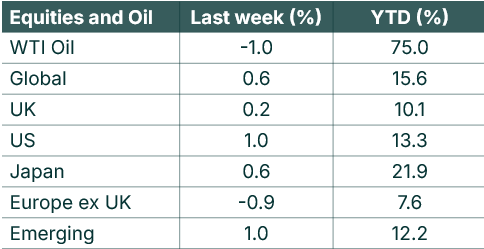
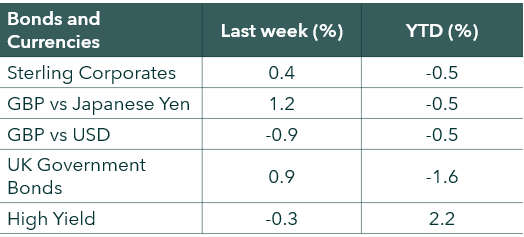
 

Source: Bloomberg: Currency: GBP.

More details


Central banks tighten, but at different speeds

The Federal Reserve raised its target range by 0.25% to 3.75% to 4.00%, whilst the Bank of Japan increased its policy rate to 1.25%, to a 31-year high. The Bank of England left the base rate unchanged at 3.75%. The Federal Reserve’s increase was its first in more than three years.
Despite differences in the pace and direction of policy, central-bank communications continued to highlight persistent inflation risks. At the Bank of England, the Monetary Policy Committee’s (MPC) commentary pointed towards inflation risks, particularly energy-driven inflation, and the MPC emphasised that it stands ready to adjust policy if evidence of persistent inflationary pressures or second-round effects emerges. Despite the decision to keep rates unchanged, gilt yields remain elevated. Separately, the MPC also unanimously agreed to continue reducing its holdings of UK government bonds, reinforcing the focus on tighter financial conditions.
Equity markets were nevertheless resilient, suggesting that markets have judged that the decisions were manageable within the current growth and earnings outlook.

Consumer demand remains resilient

Economic data did little to change the broader picture. Retail sales in both the UK and US were stronger than expected, providing evidence that household demand has remained relatively resilient despite higher borrowing costs. Higher rates affect households unevenly and often with a lag, so the impact of higher rates is yet to be seen.
Japan’s trade balance was weaker than expected, reinforcing the uneven nature of global growth. Overall, the evidence remains consistent with continued expansion, but with meaningful differences between countries and sectors.

Bond yields remain important

Government bond yields remain one of the more important influences on the investment outlook. Higher yields increase borrowing costs, tighten financial conditions and raise the return available from lower-risk assets. They can also place pressure on equity valuations, particularly where those valuations depend heavily on profits expected well into the future.

Focus shifts back towards growth

With the latest central-bank decisions behind us, attention is expected to return to economic activity and corporate fundamentals. PMI data from the UK and Germany should provide a timely, although survey-based, indication of business conditions. US new home sales will offer further evidence of the effect of higher mortgage rates, whilst Costco’s results and US Durable Goods orders will provide another perspective on economic health and consumer demand.

The value of investments and the income from them can go down as well as up and you could get back less than you invested. Past performance is not a reliable indicator of future performance.

The content of this article is not intended to be or does not constitute investment research as defined by the Financial Conduct Authority. The content should also not be relied upon when making investment decisions, and at no point should the information be treated as specific advice. The article has no regard for the specific investment objectives, financial situation or needs of any specific client, person, or entity.

Emma Matthews
About the Author

Emma is a CFA Charterholder and Chartered Fellow of the CISI. Emma focusses her time on bespoke client portfolio management and direct equity research. She has a background in asset management, in-house institutional investment management, institutional investment consultancy and retail investment management.