

 Client Login



A big week for economic data which has jolted markets a little. Inflation data and questions growing louder around AI investment financing are behind the sell off. Global equities are down, led by tech and emerging markets, but the UK and Europe managed to buck the trend with some marginal gains.
Last week
Data from the United States:
-CPI surprised to the upside: headline came in at 3.7% YoY vs 3.6% expected, and core was 2.6% YoY vs 2.5% expected
-PPI was also hot and did the most market damage; 6.3% reported vs 5.5% expected
-Import prices also rose to 8.1%, the highest level since July 2022
-Housing data were in line with expectations but have been read as weak
-Retail sales surprised positively, agreeing with the banks who cite a strong consumer
-In earnings season, banks were mixed but, on the whole, a little disappointing
-UK August GDP came in better than expected at +0.1% as opposed to -0.1% expected
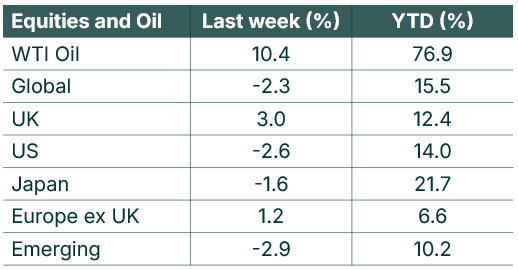
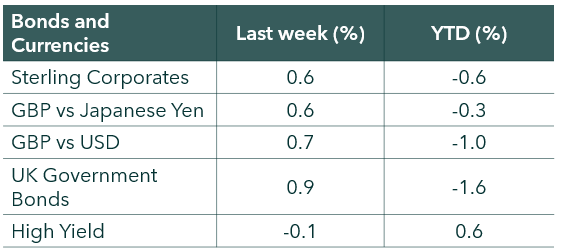
Source: Bloomberg. Currency: GBP.
Markets are starting to question in more serious terms the sustainability of financing the AI infrastructure build out. Coreweave is making headlines as the yield on its 9% coupon bond has risen to 16%, and its equity is down 25% this week. Many other names in the AI ecosystem are also negative this week, most notably Nvidia down over 5%, and Samsung and Hynix down c10% too.
This hasn’t come as a surprise to us, as we have been warning about this risk in recent weeks. We still don’t believe the AI trade has reached its crescendo, but we expected volatility to remain until there is evidence that investment will bear fruit. This price action could be a blueprint for how the market might shakeout if concerns grow larger. Companies have their debt called into question and the markets reprice accordingly. This will have a knock-on effect in the equity market, and these companies will have to carefully consider whether they are confident the return on investment will be greater than the cost of capital. Returns will then matter; all this spending will have to demonstrate return, and at this point we could start to see who the winners are.
US CPI surprised to the upside on Wednesday. Energy prices were up 5.2% for the month, and gasoline drove half the monthly increase in the headline figure. Core accelerated too as shelter, airfares, used cars, apparel, healthcare, education, and recreation all rose. PPI was a bigger surprise and hit its highest level since 2022, along with import prices. Taken together, inflation could be catching some second-round effects, which is what the fear has been since the oil price rose due to the Iran conflict. The Fed has already moved once and meets again at the end of the month, but market pricing doesn’t indicate another hike. This weeks’ data, however, may have moved that needle and they may wish to do more to get ahead of any further increases.
Banks were the main earnings reporters this week which were mixed-to-disappointing. Only Goldman Sachs managed a meaningful beat but has not been rewarded with share price performance. Most of the banks that reported indicated a strong consumer with increases in deposits and loan growth. This backs up the retail sales data which was better than forecast, but worth taking with a pinch of salt, as it is likely skewed by an increase in petrol prices and perhaps not quite as good as the headline number suggests.
US housing was in line with expectations but it was reported that August and September were the slowest month of the year for realtors. House prices only rose 1.3% YoY so the outlook for housing remains weak.
UK August GDP was a pleasant surprise, coming in positive rather than a forecast negative. Services were flat but production was up 0.8% MoM. The IMF also upgraded the outlook for the UK for FY26, but tempered 27 a little on higher oil and energy prices. The UK has grown 2.1% over the last 12 months with Q1 this year delivering 0.6% and Q2 0.5%, none of which is as bad as we sometimes feel about our own economic growth.
It’s interesting that bonds have had a quiet week in the face of all this data, although with the way inflation appears to be trending, it’s hard to believe it’s all as yet in the price. Two-sided pressure likely meant that UK and US government bonds ended the week flat but with inflation threatening to accelerate, we are still comfortable in the short end of the curve.
Next week
It’s a big week for earnings:
-SpaceX reports on Tuesday along with a number of other industrials, such as 3M, GM, Northrop Gruman, and 50 other US companies:
Meta, Tesla, and LAM on Wednesday, all in the AI trade
-Its UK inflation on Wednesday too, with forecasts looking for 3.4%, and Governor Bailey speaking later that same day
-Friday will give us flash PMIs in Europe and the US, all of which are expected to remain above 50
The content of this article is not intended to be or does not constitute investment research as defined by the Financial Conduct Authority. The content should also not be relied upon when making investment decisions, and at no point should the information be treated as specific advice. The article has no regard for the specific investment objectives, financial situation or needs of any specific client, person, or entity.