Client Login



Global markets put in a strong performance last week, rising by 3.8% on the back of strong earnings and broad-based support from the technology sector. Both profit growth at individual companies and continued strong investor demand supported the rally.
This week the focus will remain on Nvidia, which reports its results on Tuesday, and on the tech sector more broadly, with the much anticipated Anthropic IPO scheduled for Thursday.
In brief: strong earnings and technology leadership drove markets higher despite the Nvidia CEO’s resignation, while rising bond yields reinforce our preference for shorter-dated bonds and for broad diversification rather than concentration in any single company.
Last week
Global markets rose 3.8%, led by Japan (+6.3%) and strong corporate earnings, even with the Nvidia headlines
The Pound fell by 1% vs the US Dollar – a benefit to UK investors on their US assets
Bond markets sold off – yields rose after US inflation came in at 0.4% month-over-month versus 0.3% expected, with markets pricing in a December rate hike
The technology sector rallied, helped by CoreWeave’s 25% one-day jump on strong earnings and Taiwan Semiconductor’s 51% YoY revenue growth
Nvidia CEO Jensen Huang resigned after 33 years at the helm; CFO Colette Kress takes over on an interim basis, and the shares fell about 12% on the week
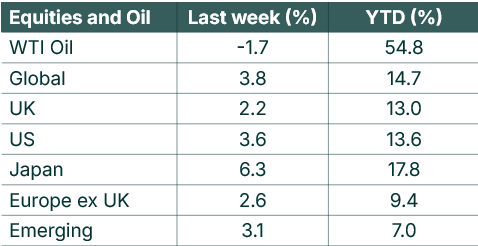
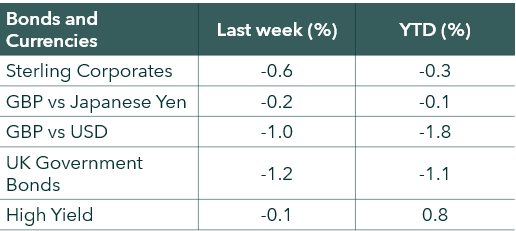
Source: Bloomberg. Currency GBP.
This week
Nvidia’s earnings on Tuesday are likely to be the focal point this week. The company is expected to generate 90% year-on-year earnings growth. Hitting that number will be key, but we’d expect the market to be more focussed on what interim CEO Colette Kress offers in the way of forward guidance.
Anthropic’s much anticipated IPO opens for trading on Thursday.
UK inflation data is due out on Wednesday – expected 1to rise to 3.6% YoY
US consumer sentiment is due out on Friday
More detail
Global stock markets rose by 3.8% last week, despite the Nvidia headlines and a higher-than-expected US inflation reading. Japan, up by 6.3%, was the best performing of the major regions, but it was strong earnings growth which powered the broad-based returns.
Corporate earnings continued to come in strong last week, with US companies now posting a blended growth rate for Q3 2026 of 31.9%. This is higher than had been expected and will mark the 3rd straight quarter of +25% earnings growth.
AI stocks stood up to be counted in the face of the Nvidia headlines – with a series of positive developments:
AI cloud platform CoreWeave posted much better-than-expected earnings numbers (seeing the stock rise 25% on the day having fallen close to 70% since the start of May)
Taiwan Semi Conductor (which counts Nvidia as its biggest customer), posted revenue growth of 51% YoY, and
AI lab Anthropic pressed ahead with its scheduled IPO (set to price on 18th November), with the offering noted to be about 6 times oversubscribed.
These positive factors, combined with the US technology sector trading at 18x forward earnings, helped support the sector and the broader market despite the resignation of Nvidia CEO, Jensen Huang.
The Nvidia leadership change was the biggest story of the week, so we set out below what happened, how the market reacted and what it means for portfolios.
Thursday last week saw Nvidia CEO Jensen Huang resign following media reports of alleged affairs, including with an alleged Chinese spy and 2 company employees. He will be replaced by CFO Colette Kress on an interim basis until a full-time successor is named.
Nvidia fell by about 12% last week on this news and is down about 30% since early October, having shed $1.8trn of market capitalisation in the process. For context, this is equivalent to 8 HSBCs, which is the biggest stock in the UK share market. Even with the fall, Nvidia remains one of the world’s biggest companies – currently the 2nd largest in the world – and makes up 4.2% of the global share index. For context, this is larger than the entirety of the UK share market, which itself comprises just a 3.5% weighting within the global share index.
Our view is that Nvidia remains an excellent company but will need to find another visionary leader to reignite long-term success. From an investment perspective, our stance has been that investors should seek more broad diversification and should not be overly exposed to any one individual company – we’d note that the top 10 companies within the global share market currently account for a c27% weighting and these companies are largely all technology companies. Regardless of Nvidia’s plight, this is too concentrated a position, in our view, for investors seeking broad diversification.
As for Nvidia itself, the company remains highly profitable and is trading at roughly 13.5x its next 12 months’ earnings – close to its cheapest valuation in a decade.
US inflation (CPI) came in at 0.4% month-over-month last week, which was higher than the 0.3% expected. This put upward pressure on bond yields and also strengthened the US Dollar against the Pound, which boosted dollar gains within the equity markets for UK investors.
US bond futures markets moved to price in a near certainty of an interest rate hike at the 9th December Federal Reserve meeting, with 2 further hikes being priced in for 2027. This represents at least 1 more rate hike than had been priced in the prior week, hence the movement up in bond yields and down in bond prices. We’d stress that bond futures markets tend to be very volatile and tend to affect the prices of longer-dated bonds to a much greater degree than shorter-dated bonds. This is one of the reasons that we retain a preference for shorter-dated bonds within our clients’ portfolios.
The value of investments and the income from them can go down as well as up and you could get back less than you invested. Past performance is not a reliable indicator of future performance.
The content of this article is not intended to be or does not constitute investment research as defined by the Financial Conduct Authority. The content should also not be relied upon when making investment decisions, and at no point should the information be treated as specific advice. The article has no regard for the specific investment objectives, financial situation or needs of any specific client, person, or entity.