Client Login




Global markets enjoyed a constructive week as investors balanced encouraging corporate earnings against a mixed set of economic data releases. Equity markets were supported by evidence that corporate profitability remains resilient, while signs of a gradually moderating US economy helped ease pressure on bond markets towards the end of the week.
Looking ahead, attention is likely to shift from earnings season towards inflation and growth data, with key releases from the US and UK expected to provide further insight into the economic outlook and the potential path of interest rates over the coming months.
Last week
Global equity markets moved higher as strong corporate earnings helped offset ongoing concerns around inflation, interest rates and global growth.
- Second-quarter earnings season remained firmly in focus. Strong results from several large companies, including Palantir, Caterpillar and Eli Lilly, supported sentiment, whilst SpaceX reported its first earnings as a public company, further highlighting investor appetite for large growth businesses.
- US economic data was mixed. Manufacturing activity improved, with the ISM Manufacturing PMI coming in stronger than both the previous month and market expectations. ISM Services PMI was broadly unchanged from June and slightly below consensus forecasts.
- Chinese trade data for July pointed to continued resilience in external demand. Whilst exports and imports remained healthy, growth was weaker than the strong June figures, illustrating the uneven nature of China’s economic recovery.
- Friday’s employment data provided a mixed picture for investors. US non-farm payrolls disappointed relative to market expectations, whilst the unemployment rate edged down from 4.2% to 4.1%, suggesting labour market conditions remain relatively stable despite signs of moderation.
This week
Investor attention now shifts from the peak of earnings season back towards inflation, growth and central bank policy.
- Although many companies are due to report results this week, most are smaller businesses with market capitalisations below $100bn. Notable names reporting include Cisco Systems and Applied Materials, whose outlook statements will be closely watched for signs of continued corporate and AI-related spending.
- Tuesday brings the Reserve Bank of Australia interest rate decision, where rates are expected to remain unchanged at 4.35%. US Existing Home Sales data for July will also be released and is expected to show activity broadly similar to June.
- US inflation data is released on Wednesday and is likely to be the most closely watched economic release of the week. Markets expect inflation to have edged higher in July, with the result likely to influence expectations for future Federal Reserve policy.
- Thursday sees a busy UK economic calendar, with particular focus on June GDP figures. Forecasts suggest growth of around 0.1%, although some analysts expect a slightly weaker reading. US Producer Price Index (PPI) data will also be released, providing a further update on inflation pressures.
- On Friday, investors will assess US retail sales and the preliminary University of Michigan Consumer Sentiment survey for August, both of which will provide a timely indication of the strength of the US consumer.
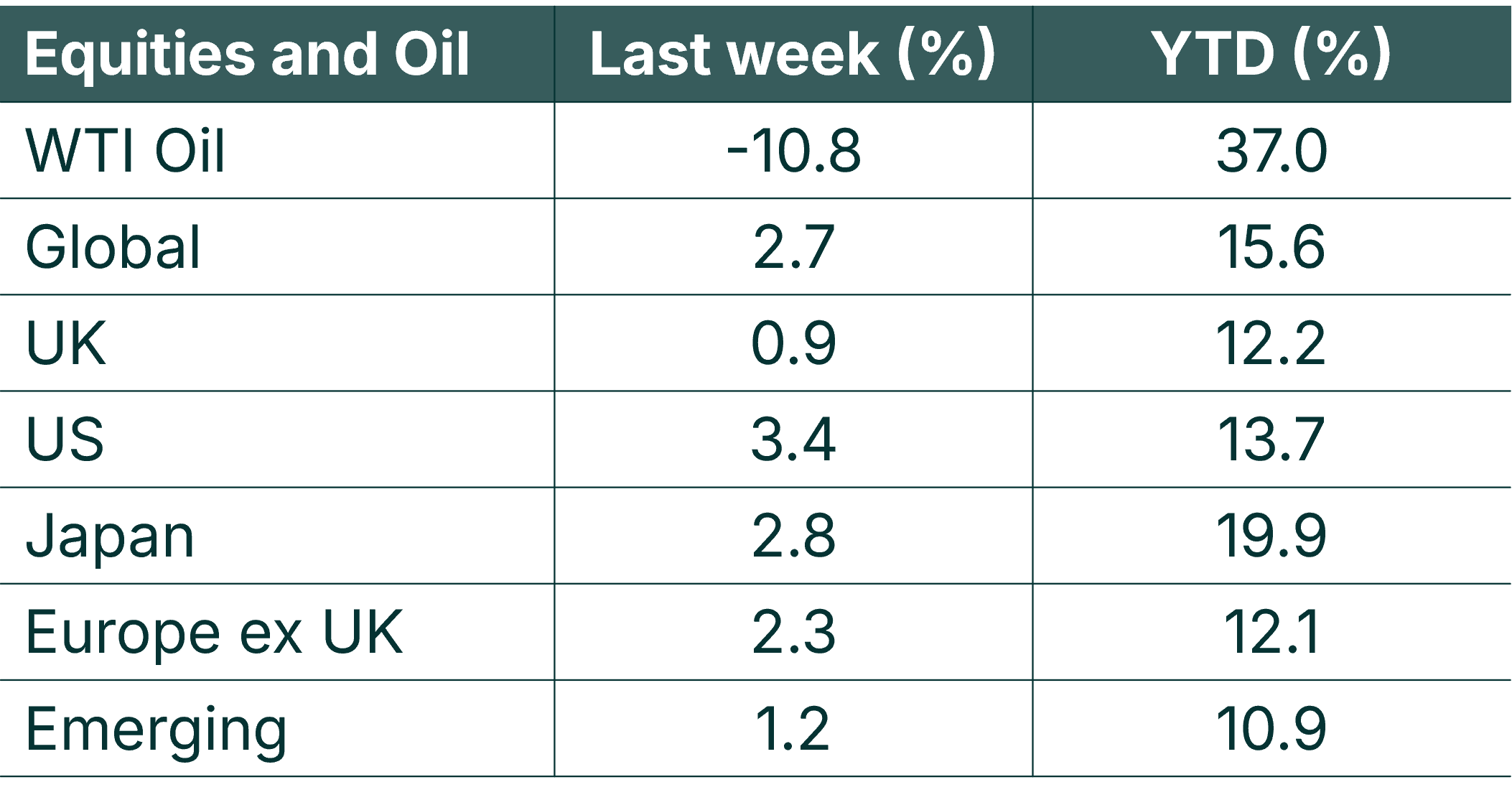
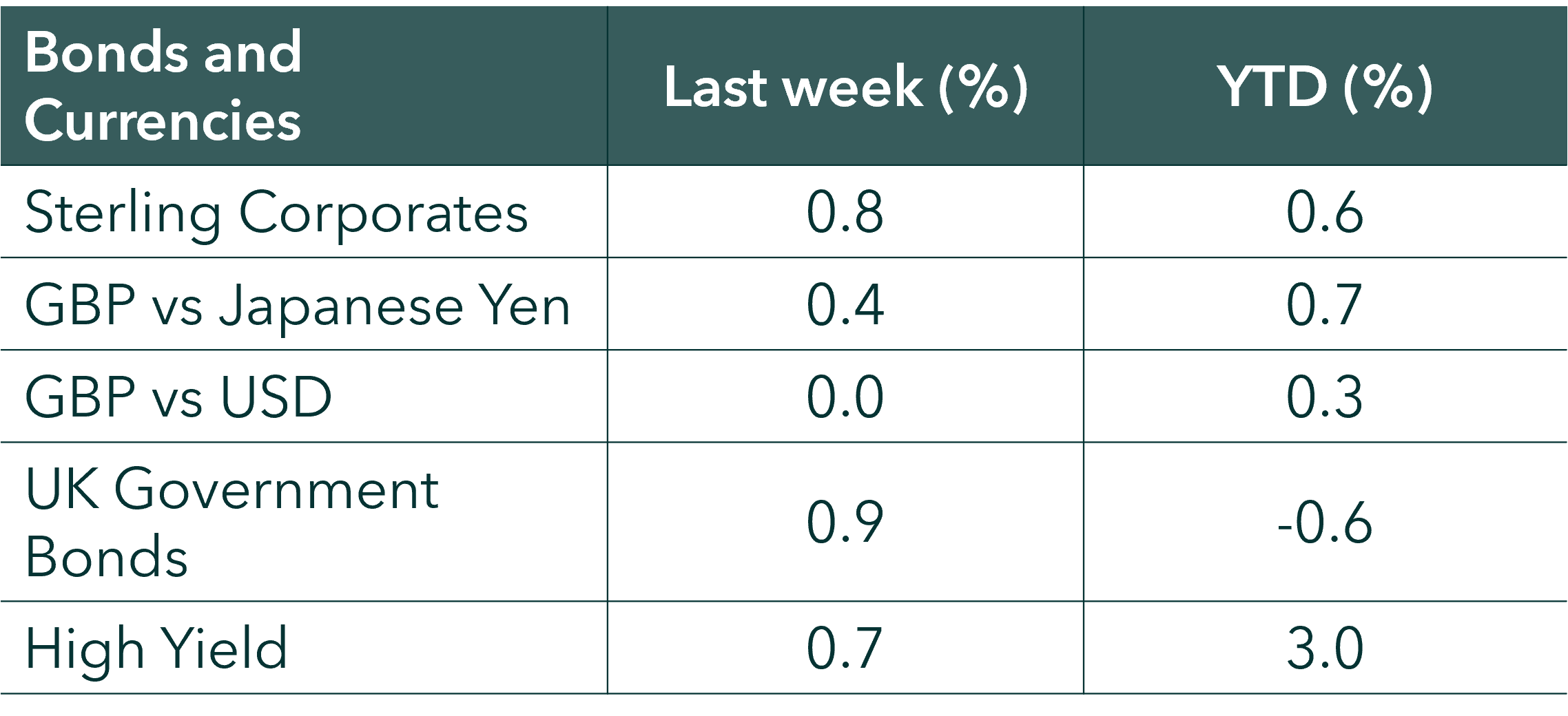
Source: Bloomberg. Currency GBP.
More details
The primary driver of market performance last week was corporate earnings season. Results have generally been stronger than expected, helping to justify elevated equity market valuations and reinforcing confidence in the profitability of many of the world’s largest businesses. Several notable companies reported during the week, including Palantir, Caterpillar and Eli Lilly, whilst SpaceX attracted significant attention as it announced its first earnings results following its market listing.
Technology and artificial intelligence remain key investment themes. Although leadership within the sector has broadened compared with earlier in the year, investors continue to focus heavily on businesses benefiting from increased investment in AI infrastructure, software and automation. The continued willingness of companies to invest despite economic uncertainty has remained a supportive backdrop for equity markets.
Economic data painted a more nuanced picture. US manufacturing activity improved and exceeded expectations, suggesting industrial activity remains resilient. However, services sector data was slightly softer, and Friday’s US employment data highlighted some moderation in labour market momentum. The combination of weaker-than-expected payroll growth alongside a small decline in the unemployment rate indicates an economy that continues to expand, albeit at a slower pace than earlier in the year.
China remained an important focus for investors. July trade data showed exports and imports continuing to grow, although not at the pace seen in June. The figures added to evidence that parts of the Chinese economy continue to recover, albeit unevenly and with ongoing reliance on external demand.
Looking ahead, markets are likely to become increasingly focused on inflation and growth data as earnings season begins to wind down. US inflation figures, UK GDP data, producer prices and retail sales all have the potential to influence expectations for interest rates and economic growth. As has been the case for much of this year, investor sentiment is likely to remain highly sensitive to incoming economic data and any resulting changes in central bank expectations.
The value of investments and the income from them can go down as well as up and you could get back less than you invested. Past performance is not a reliable indicator of future performance.
The content of this article is not intended to be or does not constitute investment research as defined by the Financial Conduct Authority. The content should also not be relied upon when making investment decisions, and at no point should the information be treated as specific advice. The article has no regard for the specific investment objectives, financial situation or needs of any specific client, person, or entity.